Life Sciences (Grade 10, Lebanon) · Chapter 8 · Tutorial exercise
Covering the soil in winter
Management and protection of fresh water · B. Protecting water · level 2
Statement
After a corn harvest, in September, two neighboring plots are treated differently: one is left bare until spring, the other is sown with a cover crop, mustard. From October to March, the nitrate content of the water that seeps below each plot, collected at a depth of one meter, is measured every month.
- Read the nitrate content below each plot in October, then in December.
- Describe how the nitrate content changes below the bare soil.
- Describe how the nitrate content changes below the mustard.
- State during which months the water that seeps below the bare soil exceeds the drinkability limit.
- Explain the origin of the nitrates present in the soil after the harvest.
- Explain the role of the mustard.
- In spring, the mustard is shredded and plowed into the soil. State what becomes of the nitrates it had absorbed.
Solution
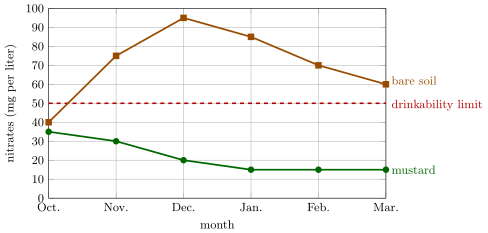
- In October, the water contains of nitrates per liter below the bare soil and per liter below the mustard. In December, it contains per liter below the bare soil and per liter below the mustard.
- Below the bare soil, the nitrate content increases sharply from October to December, from 40 to per liter, then it decreases slowly to per liter in March.
- Below the mustard, the nitrate content decreases from October onward: it goes from 35 to per liter in January, then stays stable.
- Below the bare soil, the content exceeds per liter from November to March, that is, for five months. Below the mustard, it never exceeds it.
- These nitrates are what remains of the nitrogen fertilizer that the corn did not absorb; to these are added those released by the decomposition of the crop residues. Being very soluble, they are carried away by the autumn and winter rains that seep in.
- The mustard grows in autumn. Through its roots, it absorbs the nitrates of the soil to make its organic matter. These nitrates are no longer in the soil: the water that seeps in carries almost none away. The cover crop acts as a nitrate trap.
- Once plowed in, the mustard is decomposed by the soil microorganisms. The nitrogen it contained gradually returns to the soil as nitrates, at the time when the next crop, which grows in spring, can absorb them. This must be taken into account to reduce the dose of fertilizer.
What the exercise establishes: showing, on a graph, the effect of a cover crop on the leaching of nitrates.
Similar exercises
- An aquifer over two years solved
- A borehole that is too greedy solved
- A coastal aquifer turning salty solved
- Two wastewater treatment plants solved
- A plain, an aquifer and the sea solved
The course of the chapter · All the exercises of the chapter