Life Sciences (Grade 11 Humanities, Lebanon) · Chapter 1 · Direct application of the course
From the follicle to the corpus luteum
Human reproductive physiology · level 1 (application)
Statement
The following five diagrams, placed in random order, represent what can be observed in an ovary at different times of the same 28-day cycle.
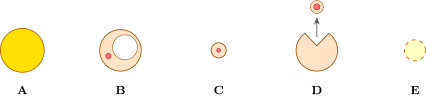
- Name the structure or event represented by each diagram.
- Put the five diagrams back in the order of the cycle.
- State the approximate day of the cycle that corresponds to diagram D.
- State the diagrams that belong to the follicular phase, then those that belong to the luteal phase.
- Specify in which case structure A does not regress at the end of the cycle.
Solution
- A: corpus luteum; B: mature follicle, with a cavity; C: young follicle; D: ovulation (the follicle ruptures and releases the oocyte); E: regressing corpus luteum.
- The order is: C, B, D, A, E.
- Ovulation (diagram D) takes place around the 14th day of a 28-day cycle.
- The follicular phase precedes ovulation: diagrams C and B. The luteal phase follows it: diagrams A and E.
- The corpus luteum regresses if there is no fertilization. If there is fertilization, and therefore the start of a pregnancy, it is maintained.
Similar exercises
- A cycle without ovulation solved
- Labeling the female reproductive system solved
- Counting days and cycles solved
- Reading the graph of the ovarian hormones solved
- Does the pituitary gland act directly on the uterus? solved
The course of the chapter · All the exercises of the chapter