Life Sciences (Grade 11 Humanities, Lebanon) · Chapter 3 · Tutorial exercise
A karyotype with 47 chromosomes
Chromosomes and gene transmission · B. The transmission of chromosomes and sex · level 3 (hard)
Statement
The following diagram represents the karyotype of a child. Both parents have an ordinary karyotype.
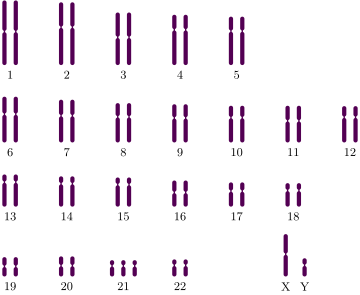
- Count the chromosomes of this karyotype.
- Identify what distinguishes it from an ordinary karyotype.
- Name this abnormality.
- State the sex of the child, justifying the answer.
- Give the number of chromosomes of the fertilized egg from which this child comes.
- One of the two gametes was ordinary. Calculate the number of chromosomes of the other gamete.
- State the number of chromosomes 21 that this abnormal gamete carried.
- Explain, using the role of meiosis, how such a gamete could have formed.
- Write a short summary: how the number of chromosomes is ordinarily maintained from one generation to the next, and why it was not maintained here.
Solution
- 47 chromosomes are counted.
- All the pairs are ordinary, except pair 21: three chromosomes are found there instead of two.
- It is a trisomy 21.
- The sex chromosomes are one X chromosome and one Y chromosome: the child is a boy.
- All the child's cells come from the fertilized egg, whose chromosomes they copied: the fertilized egg had 47 chromosomes.
- The ordinary gamete contributed 23 chromosomes: . The other gamete had 24 chromosomes.
- This gamete carried two chromosomes 21 instead of just one.
- Meiosis normally separates the two chromosomes of each pair. Here, during the meiosis that formed this gamete, the two chromosomes 21 did not separate: they went together into the same gamete, which received 24 chromosomes.
- Ordinarily, meiosis gives gametes with 23 chromosomes, one from each pair, and fertilization brings two gametes together: . The number of chromosomes thus remains the same from one generation to the next. Here, a meiosis error gave a gamete with 24 chromosomes, carrying two chromosomes 21; its meeting with an ordinary gamete gave a fertilized egg with chromosomes, including three chromosomes 21: the child has trisomy 21.
What the exercise establishes: analyzing an abnormal karyotype and tracing it back to the meiosis error that explains it.
Similar exercises
- Cells and their chromosomes solved
- A gene on a chromosome solved
- What if meiosis did not exist? solved
- Girl or boy? solved
- The chromosomes of some animals solved
The course of the chapter · All the exercises of the chapter