Life Sciences (Grade 11, Lebanon) · Chapter 2 · Tutorial exercise
A ribosome at work
From gene to protein · B. Transcription and translation · level 2
Statement
The diagram shows a moment in the translation of a messenger RNA. Reading proceeds from left to right.
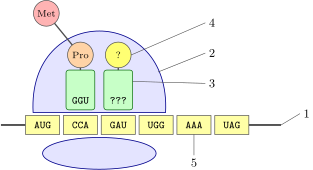
| Codon | AUG | CCA | GAU | UGG | AAA | UAG |
|---|---|---|---|---|---|---|
| Meaning | Met | Pro | Asp | Trp | Lys | stop |
- Give the label corresponding to numbers 1 to 5.
- Check that the anticodon GGU is suitable for the codon opposite which it is placed.
- Determine the anticodon replaced by the three question marks.
- Identify the amino acid replaced by a question mark.
- Describe what will happen just after the moment shown.
- Give the complete sequence of the polypeptide chain that will be released, and specify what causes its release.
Solution
- The labels are: 1, the messenger RNA; 2, the ribosome (its large subunit); 3, a transfer RNA; 4, an amino acid; 5, a codon.
- The anticodon GGU is placed opposite the codon CCA. G is complementary to C, G to C and U to A: the anticodon GGU is indeed complementary to the codon CCA.
- The transfer RNA on the right is placed opposite the codon GAU. Its anticodon is complementary to this codon: C opposite G, U opposite A, A opposite U. The anticodon is CUA.
- The codon GAU designates aspartic acid (Asp): it is the amino acid carried by this transfer RNA.
- The ribosome will form a peptide bond between proline and aspartic acid: the chain Met – Pro will be transferred onto aspartic acid. Then the ribosome will move forward by one codon to the right; the transfer RNA on the left, now unloaded, will go back into the cytoplasm, and a transfer RNA carrying tryptophan will take its place opposite the codon UGG.
- Reading continues: UGG, tryptophan; AAA, lysine; UAG, stop codon. The released chain is Met – Pro – Asp – Trp – Lys. It is the arrival of the ribosome at the stop codon UAG, to which no transfer RNA corresponds, that causes the release of the chain.
What the exercise establishes: reading a diagram of translation and applying codon-anticodon complementarity.
Similar exercises
- Two almost twin hormones solved
- Three versions of the same gene solved
- Transcribing, then translating solved
- Khorana's artificial RNAs solved
- The production of an enzyme by a pancreatic cell solved
The course of the chapter · All the exercises of the chapter