Life Sciences (Grade 11, Lebanon) · Chapter 5 · Tutorial exercise
More or fewer mitochondria
The energy of cell functioning · B. Mitochondrion and ATP · level 2
Statement
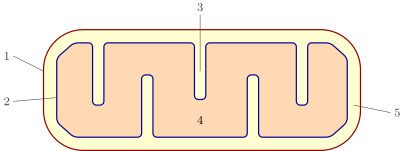
The diagram shows a mitochondrion observed with an electron microscope.
The table gives, for four types of human cells, an order of magnitude of the share of the cell's volume occupied by mitochondria.
| Cell | Activity | Share of the volume occupied by mitochondria |
|---|---|---|
| Heart muscle cell | contracts without interruption | 35% |
| Liver cell | carries out a great many syntheses | 20% |
| White blood cell at rest | not very active | 5% |
| Red blood cell | carries oxygen in the blood | 0% |
- Label the diagram by giving the names of elements 1 to 5.
- State the advantage of the folds of element 2.
- Rank the four cells in decreasing order of richness in mitochondria.
- Relate the richness in mitochondria to the activity of the cell.
- Explain this relationship.
- The red blood cell carries oxygen. Say whether it can use it to completely oxidize glucose, with justification.
Solution
- 1: outer membrane. 2: inner membrane. 3: crista, a fold of the inner membrane. 4: matrix. 5: space between the two membranes.
- The folds, or cristae, greatly increase the surface area of the inner membrane. Now, this membrane carries enzymes of respiration: the larger its surface area, the more metabolites the mitochondrion can oxidize.
- In decreasing order of richness: heart muscle cell (35%), liver cell (20%), white blood cell at rest (5%), red blood cell (0%).
- The more active a cell is, the larger the share of its volume occupied by mitochondria. The heart muscle cell, which works without stopping, is the richest in mitochondria.
- A very active cell expends a lot of energy. This energy comes from the oxidation of metabolites, which takes place in the mitochondria: a high expenditure requires many mitochondria.
- The red blood cell has no mitochondria. Now, the complete oxidation of glucose by oxygen takes place in the mitochondria: the red blood cell cannot carry it out. It carries oxygen without using it to respire.
What the exercise establishes: labeling a mitochondrion and relating the number of mitochondria to the energy expenditure of the cell.
Similar exercises
- Seeds that respire solved
- The overall balance of the oxidation of glucose solved
- Where does the cell respire? solved
- A light that reveals ATP solved
- From oxygen consumed to ATP formed solved
The course of the chapter · All the exercises of the chapter