Life Sciences (Grade 11, Lebanon) · Chapter 6 · Tutorial exercise
A cell built to contract
Energy metabolism in humans · B. The muscle fiber and its ATP · level 2
Statement
The diagram shows a small part of a muscle fiber, seen under the electron microscope. A fiber of the biceps can be 4 cm long for a diameter of 50 micrometers.
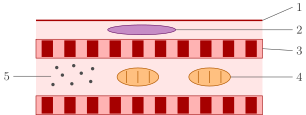
- Label the diagram by giving the names of elements 1 to 5.
- Calculate how many times longer than wide the biceps fiber is.
- A muscle fiber has several hundred nuclei. State their position in the cell.
- State the role of element 3 in contraction.
- State the role of element 4 and justify its abundance in the fiber.
- State the nature and the role of element 5.
- Justify the expression “differentiated cell” used for the muscle fiber.
Solution
- 1: plasma membrane. 2: nucleus. 3: myofibril. 4: mitochondrion. 5: glycogen granules.
- The length is 4 cm, that is, micrometers. The ratio is: The fiber is 800 times longer than it is wide: it is a very elongated cell.
- The nuclei are located at the periphery of the fiber, against the plasma membrane. The center of the cell is filled by the myofibrils.
- The myofibrils are the contractile elements of the fiber: it is they that shorten during contraction, consuming ATP.
- The mitochondria are the site of cellular respiration: they oxidize metabolites and regenerate ATP. Contraction consumes a lot of ATP: the fiber therefore has many mitochondria, placed in contact with the myofibrils.
- The glycogen granules are a glucose reserve. When broken down, this glycogen supplies on the spot the glucose that the fiber uses to regenerate its ATP.
- A differentiated cell has an organization adapted to a precise function. The muscle fiber is adapted to contraction: elongated shape, myofibrils that shorten, mitochondria and reserves that supply the energy.
What the exercise establishes: label a muscle fiber and relate each element to contraction.
Similar exercises
- Back to the washed-liver experiment solved
- At the entrance and at the exit of the liver solved
- Respiration or fermentation? solved
- Four events, three pathways solved
- Two hours of running solved
The course of the chapter · All the exercises of the chapter