Life Sciences (Grade 12 Life Sciences, Lebanon) · Chapter 11 · Tutorial exercise
Cocaine and the reuptake of dopamine
Neurotransmitters and medical applications · B. Diseases, medicines and drugs · level 2
Statement
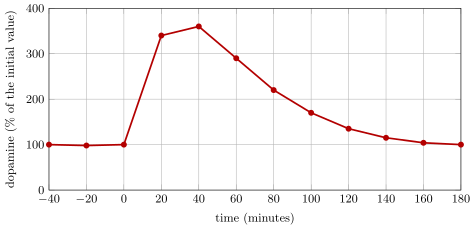
A fine probe placed in a region of the reward circuit of a rat measures the concentration of dopamine in the fluid that bathes the synapses. The animal receives an injection of cocaine at time 0 (curve constructed in the spirit of published experiments; 100 = value before the injection).
In isolated nerve terminals, the uptake of radioactive dopamine from the surrounding fluid is measured: 100 a.u. without cocaine, 15 a.u. with cocaine. Cocaine changes neither the quantity of dopamine released per action potential nor the response of the receptors to dopamine.
- Describe the evolution of dopamine after the injection.
- Deduce from the experiment on isolated terminals the site of action of cocaine.
- Explain the rise of dopamine around the synapses.
- Explain the consequence for the postsynaptic neurons of the reward circuit.
- Explain why the effect disappears in about three hours.
- Explain how repeated use can lead to tolerance, then to dependence.
Solution
- Stable at 100 before the injection, dopamine rises to 340 in 20 minutes and reaches a maximum of 360 at 40 minutes, 3.6 times its initial value. It then decreases progressively and returns to 100 at 180 minutes.
- With cocaine, the uptake of dopamine by the terminals falls from 100 to 15 a.u.: cocaine blocks the reuptake of dopamine by the presynaptic terminal. It affects neither the release nor the receptors.
- Dopamine continues to be released normally, but it is no longer taken back up: it accumulates in the cleft and around the synapses.
- The dopamine receptors are activated more strongly and for longer: the activity of the reward circuit is greatly increased, which is felt as an intense, artificial pleasure.
- Cocaine is progressively broken down and eliminated by the body: the reuptake resumes and dopamine returns to its initial level.
- Exposed repeatedly to an excess of dopamine, the postsynaptic neurons become less sensitive: the same dose has less effect (tolerance), which leads to increasing the doses. The circuit, having adapted to the drug, functions below its normal level without it: stopping causes discomfort and craving, and the person can no longer do without the drug (dependence).
What the exercise establishes: identifying a reuptake inhibitor from experimental data and explaining its consequences.
Similar exercises
- An inhibitory neurotransmitter solved
- The pain message in the spinal cord solved
- Dopamine and Parkinson's disease solved
- Tolerance to morphine solved
- How does morphine relieve pain? solved
The course of the chapter · All the exercises of the chapter