Life Sciences (Grade 12 Life Sciences, Lebanon) · Chapter 2 · Tutorial exercise
A test cross in the fruit fly
Meiosis, fertilization and genetic recombination · B. Two genes: independent or linked? · level 2
Statement
In the fruit fly, the wild-type has long wings and red eyes. Two mutations are studied: vestigial wings and sepia (dark brown) eyes. A wild-type female of pure line is crossed with a male with vestigial wings and sepia eyes: all the F1 flies are wild-type. An F1 female is then crossed with a male with vestigial wings and sepia eyes. The offspring are counted:
| Phenotype | long, red | long, sepia | vestigial, red | vestigial, sepia |
|---|---|---|---|---|
| Number | 203 | 197 | 201 | 199 |
The diagram shows the two pairs of chromosomes concerned in a cell of the F1 female at metaphase I; the alleles carried by two of the chromosomes are indicated.
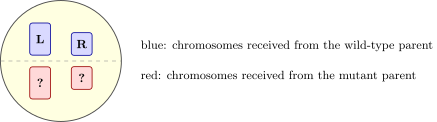
- Determine the dominant alleles. The symbols L and l are used for the wings, R and r for the eyes.
- Name the cross between the F1 female and the doubly mutant male, and give the gametes of this male.
- Calculate the percentage of each phenotype of the offspring.
- Deduce the kinds of gametes formed by the F1 female and their proportions.
- Conclude on the location of the two genes, with justification.
- Write the genotypes of the F1 female and of her four kinds of offspring.
- Give the alleles carried by the two chromosomes marked “?” in the diagram, then the gametes that this cell will give.
- Draw the other possible arrangement of the chromosomes at metaphase I and give the gametes that it produces.
- Name the recombination shown by this cross and the moment of meiosis that is responsible for it.
Solution
- The F1, born of a wild-type parent of pure line and of a doubly mutant parent, is entirely wild-type: long wings (L) is dominant over vestigial (l), red eyes (R) over sepia (r).
- It is a test cross: a double heterozygote is crossed with a doubly recessive individual. The male, l//l r//r, forms a single kind of gamete: l r.
- Total: 800 flies. Long red: ; long sepia: ; vestigial red: ; vestigial sepia: .
- Since the male brings only recessive alleles, the phenotype of each offspring reveals the gamete of the female. She forms four kinds of gametes in equal proportions: 1/4 L R, 1/4 L r, 1/4 l R, 1/4 l r.
- Four kinds of gametes in equal proportions, with as many recombinants (L r and l R, 49.75%) as parentals (L R and l r, 50.25%): the two genes are independent, carried by two different pairs of chromosomes.
- F1 female: L//l R//r. Offspring: L//l R//r (long red), L//l r//r (long sepia), l//l R//r (vestigial red), l//l r//r (vestigial sepia).
- The red chromosomes come from the mutant parent: the large one carries l, the small one carries r. In this arrangement, L and R go to the same pole, l and r to the other: the cell gives gametes L R and gametes l r.
- In the other arrangement, the small pair is turned over: the chromosome carrying r is on the same side as the one carrying L, and the one carrying R on the same side as l. The cell then gives gametes L r and gametes l R.
- It is interchromosomal recombination: at metaphase I, each pair of homologous chromosomes is oriented at random, independently of the other, and at anaphase I the homologues separate. The two arrangements are equally likely, which gives the four kinds of gametes in equal proportions.
What the exercise establishes: reading the gametes of a double heterozygote in a test cross and linking the four equal classes to the two arrangements of metaphase I.
Similar exercises
- The coat color of mice solved
- Red, white and pink flowers solved
- Two traits of the guinea pig solved
- Two linked genes in the tomato solved
- Three test crosses to compare solved
The course of the chapter · All the exercises of the chapter