Life Sciences (Grade 12 Life Sciences, Lebanon) · Chapter 3 · Tutorial exercise
An enzyme with three forms
Genetic polymorphism · B. Polymorphism in a population and its detection · level 2
Statement
An enzyme of the red blood cells, made of a single polypeptide chain, is extracted from the blood of six people and submitted to electrophoresis. After staining, the gel below is obtained. The gene that codes for this enzyme is carried by an autosome.
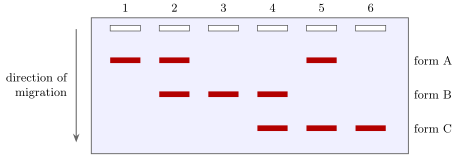
- State what the electrophoresis separates and on what property of the molecules the separation rests.
- Give the number of forms of the enzyme and deduce the number of alleles of the gene in this sample.
- Explain why a person shows either one band or two, but never three.
- Write the genotype of each of the six people, the alleles being called A, B and C.
- State what the profile of person 2 shows about the expression of the two alleles.
- Persons 2 and 6 are a couple. Determine the genotypes possible for their children.
- State whether person 3 can be a child of this couple, with justification.
Solution
- Electrophoresis separates the molecules of the enzyme placed in an electric field. The different forms migrate over different distances because they do not carry the same electric charge: they differ by at least one amino acid.
- Three positions of bands are seen: the enzyme exists in three forms, A, B and C. Each form is coded by a different allele: the gene has three alleles in this sample.
- The gene is carried by an autosome: each person has two alleles of it, on the two homologous chromosomes. A homozygote makes a single form of the enzyme, hence one band; a heterozygote makes two forms, hence two bands. Nobody can carry three alleles of the same gene.
- Person 1: A//A. Person 2: A//B. Person 3: B//B. Person 4: B//C. Person 5: A//C. Person 6: C//C.
- Person 2 makes both the form A and the form B of the enzyme: its two alleles are both expressed. At the level of the molecule, the two alleles are codominant.
- Person 2, A//B, forms gametes A and gametes B; person 6, C//C, forms only gametes C. Their children are A//C or B//C, with a probability of 1/2 each.
- Person 3 is B//B: it received an allele B from each of its parents. Person 6, C//C, cannot pass on an allele B. Person 3 cannot be a child of this couple.
What the exercise establishes: reading genotypes directly on an electrophoresis of proteins, where every allele expressed gives its own band.
Similar exercises
- Three substitutions, three consequences solved
- Insertions and deletions solved
- Polymorphic or monomorphic? solved
- Whose child, whose trace? solved
- A mutation that removes a restriction site solved
The course of the chapter · All the exercises of the chapter