Life Sciences (Grade 12 Life Sciences, Lebanon) · Chapter 3 · Direct application of the course
Three hemoglobins in one family
Genetic polymorphism · level 2
Statement
The gene of -globin has, among others, three alleles: A (normal hemoglobin, HbA), S (HbS) and C (HbC). In position 6 of the chain, HbA has a glutamic acid, negatively charged; HbS a valine, without charge; HbC a lysine, positively charged. The hemoglobin of the five members of a family is submitted to electrophoresis; the hemoglobins migrate toward the positive pole.
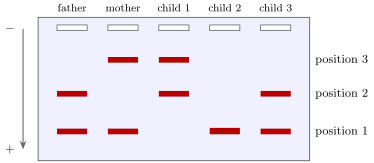
- Explain why the three hemoglobins do not migrate over the same distance.
- Assign each of the positions 1, 2 and 3 to one hemoglobin, with justification.
- Write the genotype of each member of the family.
- Check that the genotypes of the children are compatible with those of the parents.
- Give the genotypes possible for a fourth child and their probabilities.
- State what these profiles show about the expression of the alleles in a heterozygote.
Solution
- They differ by one amino acid whose electric charge is not the same: the overall charge of the molecule differs, and so does its speed in the electric field.
- The hemoglobins migrate toward the positive pole: the more negative charges a molecule carries, the farther it goes. HbA (glutamic acid, negative) migrates farthest: position 1. HbS (valine, no charge) has one negative charge fewer per chain: position 2. HbC (lysine, positive) migrates least: position 3.
- Father: bands 1 and 2, A//S. Mother: bands 1 and 3, A//C. Child 1: bands 2 and 3, S//C. Child 2: band 1 only, A//A. Child 3: bands 1 and 2, A//S.
- The father forms gametes A and S, the mother gametes A and C. Child 1 (S//C) received S from the father and C from the mother; child 2 (A//A) received A from each; child 3 (A//S) received S from the father and A from the mother. All three are compatible.
- The four encounters are equally likely: A//A, A//C, A//S and S//C, with a probability of each.
- A heterozygote makes the two hemoglobins coded by its two alleles: at the level of the protein, both alleles are expressed (codominance).
Similar exercises
- A mutation that removes a restriction site solved
- Passed on or not? solved
- Four alleles of one gene solved
- One gene, two populations solved
- A silent mutation that can be seen solved
The course of the chapter · All the exercises of the chapter