Life Sciences (Grade 12 Life Sciences, Lebanon) · Chapter 3 · Tutorial exercise
Whose child, whose trace?
Genetic polymorphism · B. Polymorphism in a population and its detection · level 2
Statement
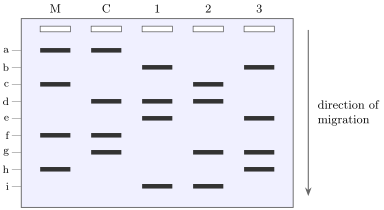
The DNA of a mother (M), of her child (C) and of three men (1, 2, 3), one of whom may be the father, is cut by a restriction enzyme. The fragments of several very variable regions are separated by electrophoresis and revealed with probes. The diagram shows the DNA profiles obtained; the lines on the left mark the positions a to i.
- State the role of the restriction enzyme, then that of the electrophoresis, in this technique.
- Explain which bands, a or i, correspond to the longest fragments.
- List the positions of the bands of each of the five profiles.
- Explain why every band of the child must be found in the mother or in the father.
- Identify the bands that the child received from its mother, then those that come from its father.
- Determine which of the three men can be the father, with justification.
- A trace of blood found on an object gives a profile with the bands b, d, e and i. State what can be concluded.
- Explain why two people have practically no chance of having the same profile, and name the exception.
Solution
- The restriction enzyme cuts the DNA at each of its restriction sites, which gives fragments whose lengths depend on the person. The electrophoresis separates these fragments according to their length.
- The shorter a fragment is, the farther it migrates. The bands a, closest to the wells, correspond to the longest fragments; the bands i, to the shortest.
- Mother: a, c, f, h. Child: a, d, f, g. Man 1: b, d, e, i. Man 2: c, d, g, i. Man 3: b, e, g, h.
- The child received half of its DNA from its mother and half from its father: each of its fragments was inherited from one of them.
- The bands a and f of the child are present in the mother: they come from her. The bands d and g are absent from the mother: they come from the father.
- The father must have both the band d and the band g. Man 1 has d but not g; man 3 has g but not d; man 2 has both. Only man 2 can be the father; men 1 and 3 are excluded.
- The profile b, d, e, i is identical, band for band, to that of man 1 and differs from all the others: the blood very probably comes from man 1.
- The regions analyzed are very variable: each exists in many versions of different lengths in the population, and each person carries its own combination, inherited from its parents. The probability that two people share all their bands is extremely low. The exception is identical twins, who come from the same fertilized egg and have the same DNA.
What the exercise establishes: reading DNA profiles for a paternity test, by exclusion, and for the identification of a person.
Similar exercises
- Three substitutions, three consequences solved
- Insertions and deletions solved
- Polymorphic or monomorphic? solved
- An enzyme with three forms solved
- A mutation that removes a restriction site solved
The course of the chapter · All the exercises of the chapter