Life Sciences (Grade 12 Life Sciences, Lebanon) · Chapter 4 · Tutorial exercise
A family, a pedigree, a prenatal diagnosis
Human genetics, predictions and prenatal diagnosis · C. Chromosomal mutations and prenatal diagnosis · level 3 (hard)
Statement
A hereditary disease of metabolism is present in two families. A man, II-2, and his wife, II-3, each have an affected brother or sister. II-3 is pregnant, and the couple asks for genetic counseling.
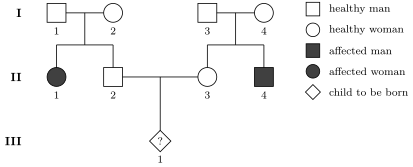
The gene concerned is known. With a restriction enzyme and a probe, the normal allele gives a fragment of 3.0 kb and the allele of the disease a fragment of 2.0 kb. The DNA of several members of the family, and that of cells of the fetus sampled at week 11 of the pregnancy, is analyzed.
| Person | I-1 | I-2 | II-1 | II-2 | II-3 | II-4 | Fetus |
|---|---|---|---|---|---|---|---|
| Band of 3.0 kb | yes | yes | no | yes | yes | no | yes |
| Band of 2.0 kb | yes | yes | yes | yes | yes | yes | no |
- Show, from the pedigree, that the allele of the disease is recessive. Choose symbols.
- Show, from the pedigree, that the gene is autosomal.
- Calculate, before any DNA analysis, the probability that II-2 is a carrier, then the same probability for II-3.
- Calculate, before any DNA analysis, the risk for the child to be born to be affected.
- Name the sampling technique used at week 11 and state what is sampled.
- Explain why two DNA fragments of different lengths give two distinct bands.
- Determine the genotypes of II-1, II-2 and II-3 from the table, and check that they agree with the pedigree.
- Give the risk for a child of this couple once the genotypes of II-2 and II-3 are known.
- Determine the genotype of the fetus and conclude.
- State two points that the physician must explain to the couple before such a sampling.
Solution
- I-1 and I-2 are healthy and their daughter II-1 is affected: a dominant allele would be expressed in one of the parents. The allele of the disease is recessive, written m; the normal allele is written N.
- If the gene were carried by the Y chromosome, no woman would be affected: II-1 is. If it were carried by the X chromosome, the affected daughter II-1 would have two X chromosomes carrying m, one of them received from her father I-1, who would then be affected: he is healthy. The gene is autosomal.
- The parents of II-2 are both N//m, since they have an affected child. II-2 is healthy: among the three possible combinations, N//N, N//m and N//m, two are carriers. Probability: 2/3. The same reasoning applies to II-3, whose brother II-4 is affected: 2/3.
- The child is affected if both parents are carriers and both pass on m: .
- At week 11, it is a chorionic villus sampling: a fragment of the chorionic villi of the placenta is taken; their cells have the same DNA as the fetus.
- In the gel, the shorter a fragment is, the farther it migrates: the fragment of 2.0 kb goes farther than that of 3.0 kb. The probe then reveals each of them as a band.
- II-1 shows only the band of 2.0 kb: she is m//m, in agreement with her phenotype. II-2 and II-3 show both bands: they are N//m, healthy carriers, in agreement with their phenotype.
- Both parents are certainly carriers: the risk is 1/4 at each pregnancy.
- The fetus shows only the band of 3.0 kb: it is N//N. It will not be affected, and it is not even a carrier.
- The sampling involves a risk of miscarriage, which must be weighed against the risk of the disease; the result tells only about the gene studied; the couple must also have thought about what it will decide according to the result. Any two of these points are accepted.
What the exercise establishes: the whole path of genetic counseling: mode of inheritance from the pedigree, risk as a product of probabilities, then replacement of the probability by a certainty through DNA analysis.
Similar exercises
- Phenylketonuria: evaluating a risk before a birth solved
- Polydactyly solved
- Duchenne muscular dystrophy solved
- Color blindness in boys and in girls solved
- An unexpected karyotype solved
The course of the chapter · All the exercises of the chapter