Life Sciences (Grade 12 Life Sciences, Lebanon) · Chapter 4 · Direct application of the course
A first pedigree
Human genetics, predictions and prenatal diagnosis · level 1 (application)
Statement
The pedigree below shows the transmission of a hereditary disease in a family.
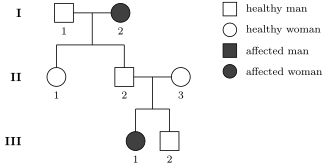
- State what the symbols I-2, II-2 and III-1 stand for.
- Determine whether the allele of the disease is dominant or recessive, with justification.
- Show that the gene is not carried by a sex chromosome.
- Write the genotypes of all the members of the family; when two genotypes are possible, give both.
- Calculate the risk for a third child of the couple II-2 and II-3 to be affected.
Solution
- I-2: an affected woman of the first generation. II-2: a healthy man of the second generation, son of I-1 and I-2. III-1: an affected girl of the third generation, daughter of II-2 and II-3.
- II-2 and II-3 are healthy and their daughter III-1 is affected: if the allele of the disease were dominant, one of them would be affected. The allele is recessive (m); the normal allele is dominant (N).
- Y chromosome: women (I-2, III-1) are affected, which is impossible. X chromosome: the affected girl III-1 would be and her father II-2 would be , affected; he is healthy. (Likewise, the affected mother I-2, , would have only affected sons, and II-2 is healthy.) The gene is autosomal.
- I-2 and III-1: m//m. II-1 and II-2, healthy children of an m//m mother: N//m. II-3, healthy mother of an affected child: N//m. I-1: N//N or N//m. III-2, healthy child of two heterozygotes: N//N or N//m.
- Both parents are N//m: the risk is .
Similar exercises
- Hemophilia in a family solved
- Autosomal or X-linked? solved
- The karyotype of a newborn solved
- A prenatal diagnosis by DNA analysis solved
- Two diseases in one family solved
The course of the chapter · All the exercises of the chapter