Life Sciences (Grade 12 Life Sciences, Lebanon) · Chapter 4 · Tutorial exercise
Albinism in a family
Human genetics, predictions and prenatal diagnosis · A. Autosomal inheritance: reading a pedigree and calculating a risk · level 1 (application)
Statement
Albinism is a hereditary anomaly in which the skin, the hair and the eyes contain no melanin. The pedigree below is that of a family in which two children are albino. In this pedigree, squares stand for men, circles for women, filled symbols for affected persons, and the double line for a union between relatives.
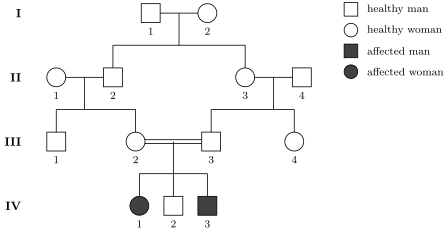
- Determine whether the allele responsible for albinism is dominant or recessive, with justification. Choose symbols.
- Show that the gene is not carried by the Y chromosome.
- Show that the gene is not carried by the X chromosome.
- Write the genotypes of IV-1, IV-3, III-2 and III-3.
- State the kinship of III-2 and III-3 and name their common ancestors.
- Explain how this kinship accounts for the birth of albino children, knowing that albinism is rare in the population.
- Calculate the risk for a fourth child of the couple III-2 and III-3 to be albino.
- Calculate the probability that IV-2 is a carrier of the allele.
Solution
- III-2 and III-3 are not albino, and they have albino children, IV-1 and IV-3. If the allele of albinism were dominant, one parent at least would carry it and would be albino. The allele is therefore recessive, written a; the normal allele, dominant, is written A.
- If the gene were carried by the Y chromosome, only men would be affected. IV-1 is an albino girl: the hypothesis is rejected.
- If the gene were carried by the X chromosome, the albino girl IV-1, of recessive phenotype, would have two X chromosomes carrying a, one of which would come from her father. Her father III-3, who has a single X, would then be albino. III-3 is not: the hypothesis is rejected. The gene is autosomal.
- IV-1 and IV-3, of recessive phenotype, are a//a. Each received one allele a from each parent; III-2 and III-3, not albino, are therefore heterozygous A//a.
- III-2 is the daughter of II-2, and III-3 the son of II-3; II-2 and II-3 are brother and sister. III-2 and III-3 are first cousins: their common ancestors are their grandparents I-1 and I-2.
- One of the grandparents, I-1 or I-2, carried the allele a. It passed it on to both II-2 and II-3, who passed it on to III-2 and III-3: the two cousins carry copies of the same allele of their common ancestor. In the population the allele is rare, and two carriers taken at random seldom meet; consanguinity makes this meeting much more likely.
- Each parent, A//a, forms 1/2 of gametes A and 1/2 of gametes a. The probability that the child receives a from both is .
- IV-2 is not albino: he is not a//a. Among the three other equally likely combinations, A//A, A//a and A//a, two are heterozygous: the probability that he is a carrier is 2/3.
What the exercise establishes: the complete analysis of an autosomal recessive pedigree, and the role of consanguinity in the appearance of a rare recessive trait.
Similar exercises
- Phenylketonuria: evaluating a risk before a birth solved
- Polydactyly solved
- Duchenne muscular dystrophy solved
- Color blindness in boys and in girls solved
- An unexpected karyotype solved
The course of the chapter · All the exercises of the chapter