Life Sciences (Grade 12 Life Sciences, Lebanon) · Chapter 4 · Tutorial exercise
An unexpected karyotype
Human genetics, predictions and prenatal diagnosis · C. Chromosomal mutations and prenatal diagnosis · level 2
Statement
A man consults for sterility. His karyotype is shown below (diagram). He has normal color vision. His father also has normal vision; his mother is color-blind. Color blindness is due to a recessive allele d of a gene carried by the X chromosome (normal allele N).
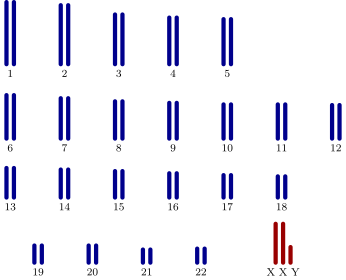
- Count the chromosomes of this karyotype and describe its anomaly.
- Write the formula of this karyotype and name the syndrome.
- Give the two kinds of abnormal gametes whose fertilization can lead to such a karyotype.
- Write the genotypes of the father and of the mother for the gene of color vision.
- This man has normal vision. Deduce from which parent he received the allele N, and which sex chromosomes each parent passed on to him.
- Deduce in which parent, and at which division of meiosis, the nondisjunction took place, with justification.
- Describe the four gametes produced by the meiosis concerned.
- State what the karyotype of this man shows about the role of the Y chromosome.
Solution
- The karyotype has 22 pairs of autosomes, that is 44, and three sex chromosomes, two X and one Y: 47 chromosomes instead of 46. There is one sex chromosome too many.
- 47,XXY: Klinefelter syndrome.
- An oocyte carrying two X chromosomes fertilized by a normal spermatozoon carrying Y; or a normal oocyte carrying one X fertilized by a spermatozoon carrying both X and Y.
- The father has normal vision: . The mother is color-blind: .
- The mother has only alleles d: she cannot have passed on N. The allele N comes from the father, on his X chromosome. The Y chromosome also comes from the father. The man therefore received X and Y from his father, and one X carrying d from his mother: his genotype is .
- The spermatozoon carried both X and Y. These are the two homologous chromosomes of the pair of sex chromosomes of the father: they normally separate at anaphase I. The nondisjunction took place in the father, at meiosis I.
- After meiosis I, one cell has X and Y, each with two chromatids, and the other has no sex chromosome. Meiosis II separates the chromatids: two spermatozoa carry X and Y (24 chromosomes), and two carry no sex chromosome (22 chromosomes).
- This person has two X chromosomes, like a woman, and yet is a man: the presence of the Y chromosome determines the male sex.
What the exercise establishes: interpreting an abnormal karyotype and using an X-linked trait as a marker to locate the nondisjunction in one parent and at one division.
Similar exercises
- Phenylketonuria: evaluating a risk before a birth solved
- Polydactyly solved
- Duchenne muscular dystrophy solved
- Color blindness in boys and in girls solved
- A family, a pedigree, a prenatal diagnosis solved
The course of the chapter · All the exercises of the chapter