Life Sciences (Grade 12 Life Sciences, Lebanon) · Chapter 4 · Direct application of the course
Autosomal or X-linked?
Human genetics, predictions and prenatal diagnosis · level 2
Statement
The pedigree shows a family in which several men have an anomaly of vision.
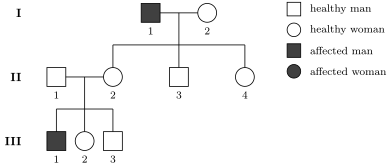
- Show that the allele of the anomaly is recessive.
- Show that the gene is not carried by the Y chromosome.
- Show that the pedigree alone does not allow one to choose between an autosomal gene and an X-linked gene.
- An analysis shows that II-1 does not carry the allele of the anomaly. Conclude.
- Write the genotypes of I-1, I-2, II-2, II-3 and III-1.
- Calculate the probability that III-2 is a carrier.
Solution
- II-1 and II-2 are unaffected and their son III-1 is affected: the allele of the anomaly is recessive (a); the normal allele is N.
- The affected father I-1 would pass his Y chromosome, and the anomaly, on to all his sons; his son II-3 is unaffected. (Likewise, III-1 would have an affected father.) The hypothesis is rejected.
- Autosomal hypothesis: I-1 is a//a; his children II-2, II-3, II-4 are N//a; if II-1 is also N//a, III-1 can be a//a. Nothing contradicts it. X-linked hypothesis: I-1 is ; his daughter II-2 is and can have an affected son ; II-3 received his X from his mother. Nothing contradicts it either. Both hypotheses fit the pedigree.
- With an autosomal gene, III-1 would be a//a and would have received a from his father II-1, who does not carry it: impossible. The gene is carried by the X chromosome.
- I-1: . II-2: (she received from her father). II-3: . III-1: . I-2: or (her children do not allow one to decide).
- III-2 received from her father II-1 and, from her mother II-2, or : she is a carrier with a probability of .
Similar exercises
- A first pedigree solved
- Hemophilia in a family solved
- The karyotype of a newborn solved
- A prenatal diagnosis by DNA analysis solved
- Two diseases in one family solved
The course of the chapter · All the exercises of the chapter