Life Sciences (Grade 12 Life Sciences, Lebanon) · Chapter 4 · Tutorial exercise
Duchenne muscular dystrophy
Human genetics, predictions and prenatal diagnosis · B. Sex-linked inheritance · level 2
Statement
Duchenne muscular dystrophy is a severe disease of the muscles. The pedigree is that of a family concerned; the woman II-4 is pregnant. A DNA analysis has shown that the men II-1 and II-5 do not carry the allele of the disease.
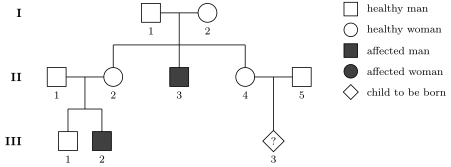
- Determine whether the allele of the disease is dominant or recessive, with justification. Choose symbols.
- Show that the gene is not carried by the Y chromosome.
- Show that the gene is not autosomal, and conclude.
- Write the genotypes of the men II-3, III-2, I-1 and II-1.
- Determine the genotypes of the women I-2 and II-2, with justification.
- Calculate the probability that II-4 is a carrier.
- Calculate the risk for the child to be born to be affected.
- An ultrasound shows that the child is a boy. Calculate the new risk.
- State what the risk would have been for a girl, with justification.
Solution
- I-1 and I-2 are healthy and their son II-3 is affected. If the allele of the disease were dominant, one of the parents would be affected. The allele is recessive, written d; the normal allele is written N.
- If the gene were carried by the Y chromosome, the affected boy II-3 would have received it from his father I-1, who would be affected. I-1 is healthy: the hypothesis is rejected.
- If the gene were autosomal, the affected boy III-2 would be d//d and would have received one allele d from his father II-1. II-1 does not carry the allele: the hypothesis is rejected. The gene is carried by the X chromosome.
- Affected men: II-3 and III-2 are . Healthy men: I-1 and II-1 are .
- A boy receives Y from his father and his X from his mother. II-3 received from I-2, and III-2 received from II-2. Both women are healthy: they are carriers, .
- II-4 received from her father I-1 and, from her mother I-2, either or , with a probability of 1/2 each. The probability that II-4 is a carrier is 1/2.
- The father II-5 is . If II-4 is a carrier, the couple has 1/4 of affected children: only the boys who receive , that is, . Risk: .
- For a boy, who receives Y from his father, everything depends on the X of the mother: if she is a carrier, one boy in two is affected. Risk: .
- A girl receives from her father II-5: she has at least one normal allele, which is dominant. The risk is zero; she may only be a carrier.
What the exercise establishes: the reasoning that establishes X-linked recessive inheritance, and the calculation of a risk that depends on the sex of the child.
Similar exercises
- Albinism in a family solved
- Phenylketonuria: evaluating a risk before a birth solved
- Polydactyly solved
- Color blindness in boys and in girls solved
- An unexpected karyotype solved
The course of the chapter · All the exercises of the chapter