Life Sciences (Grade 12 Life Sciences, Lebanon) · Chapter 4 · Tutorial exercise
Polydactyly
Human genetics, predictions and prenatal diagnosis · A. Autosomal inheritance: reading a pedigree and calculating a risk · level 2
Statement
Polydactyly is the presence of an extra finger or toe. The pedigree shows a family in which several persons have this trait (filled symbols).
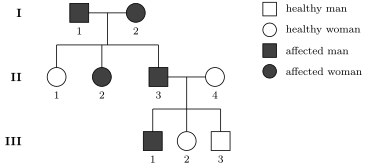
- Show, using the couple I-1 and I-2 and their children, that the allele of polydactyly is dominant. Choose symbols.
- Show that the gene is not carried by the X chromosome.
- Show that the gene is not carried by the Y chromosome.
- Write the genotypes of I-1, I-2 and II-1.
- Give the genotypes possible for II-2, with their probabilities.
- Determine the genotype of II-3, using his children.
- Calculate the probability for a fourth child of the couple II-3 and II-4 to have polydactyly.
- Compare the appearance of this pedigree with that of a recessive disease.
Solution
- I-1 and I-2 both have polydactyly, and their daughter II-1 does not. If the allele of polydactyly were recessive, both parents would be homozygous for it and all their children would have the trait. The normal phenotype of II-1 is therefore the recessive one: the allele of polydactyly, P, is dominant over the normal allele, p.
- If the gene were carried by the X chromosome, the father I-1, affected, would have an X carrying P and would pass it on to all his daughters, who would all be affected. II-1 is his daughter and is not affected: the hypothesis is rejected.
- If the gene were carried by the Y chromosome, no woman would be affected. I-2 and II-2 are: the hypothesis is rejected. The gene is autosomal.
- II-1, of recessive phenotype, is p//p; she received p from each parent. I-1 and I-2, affected, are therefore P//p.
- The cross P//p × P//p gives 1/4 P//P, 1/2 P//p and 1/4 p//p. II-2 is affected: she is P//P with a probability of 1/3 or P//p with a probability of 2/3.
- II-3 is affected and has two unaffected children, III-2 and III-3, who are p//p and received p from him. II-3 is P//p.
- II-3, P//p, forms 1/2 of gametes P and 1/2 of gametes p; II-4, p//p, forms only gametes p. The probability of a child P//p, with polydactyly, is 1/2.
- Here the trait is present in each generation and every affected person has an affected parent; two affected parents can have an unaffected child. In a recessive disease, affected children are usually born of two healthy parents, and the disease may skip generations.
What the exercise establishes: proving dominance with two affected parents who have an unaffected child, and excluding X-linkage with an affected father and his unaffected daughter.
Similar exercises
- Albinism in a family solved
- Phenylketonuria: evaluating a risk before a birth solved
- Duchenne muscular dystrophy solved
- Color blindness in boys and in girls solved
- An unexpected karyotype solved
The course of the chapter · All the exercises of the chapter