Life Sciences (Grade 12 Life Sciences, Lebanon) · Chapter 4 · Direct application of the course
The karyotype of a newborn
Human genetics, predictions and prenatal diagnosis · level 2
Statement
A woman of 41 gives birth to a child whose karyotype is shown below (diagram).
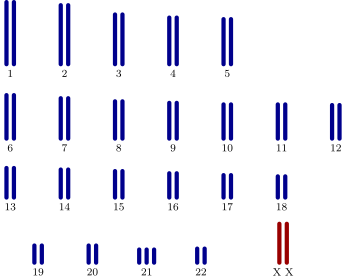
- Give the sex of the child and the number of its chromosomes.
- Identify the anomaly and write the formula of the karyotype.
- Explain why this anomaly is called a chromosomal mutation and not a gene mutation.
- Give the number of chromosomes of the two gametes that formed this child, in the most frequent case.
- Describe the two accidents of meiosis that can produce a gamete with two chromosomes 21.
- The risk of this anomaly is about 1 in 1,441 for a mother of 20 and 1 in 84 for a mother of 40. Relate this fact to the formation of the oocytes.
- Name the examination that could have detected this anomaly before birth, and the sampling it requires.
Solution
- Two X chromosomes and no Y: a girl. chromosomes.
- There are three chromosomes 21: trisomy 21 (Down syndrome). Formula: 47,XX,+21.
- No gene has a changed sequence: a whole chromosome is present in excess. The anomaly concerns the number of chromosomes and is seen on the karyotype.
- An oocyte with 24 chromosomes, including two chromosomes 21, and a normal spermatozoon with 23 chromosomes.
- At meiosis I, the two homologous chromosomes 21 fail to separate and go to the same pole. Or, at meiosis II, the two chromatids of one chromosome 21 fail to separate and go to the same gamete.
- The oocytes begin meiosis before the woman's birth and remain blocked in prophase I until their ovulation, here for about forty years. The longer this arrest lasts, the more frequent the errors of separation: the risk rises with the age of the mother.
- A fetal karyotype, established on fetal cells obtained by amniocentesis (weeks 15 to 20) or by chorionic villus sampling (weeks 10 to 12).
Similar exercises
- A first pedigree solved
- Hemophilia in a family solved
- Autosomal or X-linked? solved
- A prenatal diagnosis by DNA analysis solved
- Two diseases in one family solved
The course of the chapter · All the exercises of the chapter