Life Sciences (Grade 12 Life Sciences, Lebanon) · Chapter 7 · Direct application of the course
Delaying an autoimmune diabetes
Deficiencies and malfunctioning of the immune system · level 3 (hard)
Statement
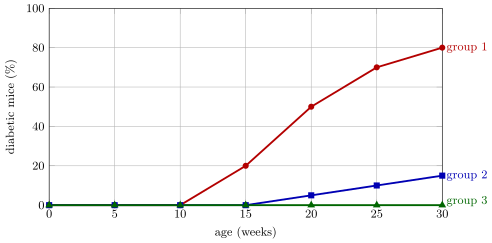
Mice of a strain that spontaneously develops an autoimmune diabetes are divided into three groups. Group 1 receives no treatment; group 2 receives, every week from the age of 4 weeks, an immunosuppressant that prevents T lymphocytes from multiplying; group 3 was thymectomized at birth. The percentage of diabetic mice is followed in each group (constructed data).
At 30 weeks, the mice of group 2 catch infections more often than those of group 1.
- Describe the evolution of diabetes in group 1.
- Compare groups 1 and 3, then conclude on the cells responsible for the disease.
- Compare groups 1 and 2, then conclude on the effect of the immunosuppressant.
- Explain, at the level of the pancreas, how these cells cause diabetes.
- Explain the last observation.
- Discuss the benefit and the limit of an immunosuppressive treatment for a person at high risk of type 1 diabetes.
Solution
- No mouse is diabetic before 10 weeks. The percentage then rises: 20% at 15 weeks, 50% at 20 weeks and 80% at 30 weeks. The disease appears progressively, after a silent period.
- In group 3, without a thymus, no mouse becomes diabetic, against 80% in group 1. Without a thymus there are no mature T lymphocytes: T lymphocytes are necessary for the disease to appear.
- With the immunosuppressant, only 15% of the mice are diabetic at 30 weeks, against 80% without treatment, and the first cases appear five weeks later. By preventing the multiplication of T lymphocytes, the drug prevents or delays the disease in most mice.
- T lymphocytes that recognize a protein of the cells are activated, multiply and invade the islets of the pancreas; cytotoxic T lymphocytes destroy the cells. Insulin is no longer secreted and the blood glucose level rises.
- The immunosuppressant does not act only on the lymphocytes that attack the cells: it slows down all the T lymphocytes. The responses against microbes are weakened: the treated mice are partly immunodeficient.
- Benefit: started before the cells are destroyed, the treatment could preserve the secretion of insulin. Limit: it must be continued for a long time and exposes the person to infections; the risk must be weighed against that of a disease which can be treated with insulin.
Similar exercises
- From the screening test to the treatment solved
- Mice born without a thymus solved
- HIV and its target cells solved
- The follow-up of a patient solved
- A muscle that tires too quickly solved
The course of the chapter · All the exercises of the chapter