Life Sciences (Grade 12 Sociology and Economics, Literature and Humanities, Lebanon) · Chapter 1 · Tutorial exercise
A school canteen menu
The basic principles of a balanced diet · C. Constructing and criticizing a balanced food ration · level 3 (hard)
Statement
A school wants to check the meals of a 16-year-old boy who has breakfast and lunch at school and the rest at home (need: 13 300 kJ per day). The graph shows the energy supplied by each meal of his day.
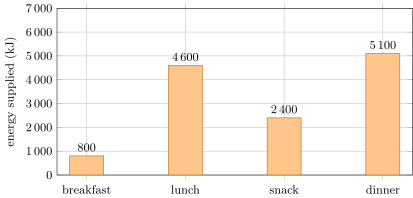
The school also notes the composition of his day: 400 g of carbohydrates (of which 140 g of sugars, mostly from soft drinks and biscuits eaten at the afternoon snack), 125 g of lipids and 80 g of proteins. No fruit and only one dairy product are eaten in the day.
- Calculate the total energy supplied in the day using the graph, and compare it with the need.
- Calculate the share of the day's energy supplied by breakfast and by dinner, and compare them with the guidelines (breakfast 20 to 25%, dinner about 30%).
- Calculate the energy supplied by carbohydrates, lipids and proteins from the composition, and check that it agrees with the graph.
- Calculate the share of each nutrient in the energy, and compare with the guidelines.
- Calculate the share of the energy coming from sugars, and compare it with the WHO recommendation (less than 10%).
- Pick out the food groups that are insufficient.
- Write a short paragraph of advice for this student, with at least three concrete changes.
Solution
- kJ, slightly below the need of kJ (about 3% less).
- Breakfast: %, far below the 20 to 25% advised. Dinner: %, well above about 30%. The energy is badly spread over the day: almost nothing in the morning, too much in the evening.
- Carbohydrates: kJ; lipids: kJ; proteins: kJ. Total: kJ, which agrees with the kJ of the graph.
- Carbohydrates: %; lipids: %; proteins: %. Lipids are in excess and proteins slightly lacking.
- Sugars: kJ, that is, % of the energy: almost twice the limit of 10% recommended by the WHO.
- Vegetables and fruits (no fruit in the day) and milk and dairy products (only one) are insufficient.
- For example: “Your day supplies about the right quantity of energy, but it is badly organized. Eat a real breakfast, with bread, labneh or cheese, a glass of milk and a fruit, so that the morning receives about a quarter of your energy. At the afternoon snack, replace the soft drinks and biscuits with water, a fruit and a yogurt: you will lower your sugars and add the dairy products and fruits that are missing. In the evening, eat a lighter dinner, with less fried food and more vegetables, and add a portion of legumes, eggs or fish to your meals to raise your proteins.”
What the exercise establishes: criticizing a real ration on all its points: total energy, sharing between meals, share of each nutrient, sugars and food groups.
Similar exercises
- Two brothers, two balances solved
- A protein that is not enough solved
- Brown rice, white rice solved
- Enough iron? solved
- Is this ration balanced? solved
The course of the chapter · All the exercises of the chapter