Mathematics (Grade 10, Lebanon) · Chapter 1 · Tutorial exercise
Classifying statistical variables: qualitative or quantitative, discrete or continuous
Statistical vocabulary · A. Population, individual, sample and nature of a variable · level 2
Statement
A statistical study is carried out on a set of motor vehicles. For each vehicle, the following eight variables are recorded:
- : the make of the vehicle;
- : the number of seats;
- : the average fuel consumption (in liters per km);
- : the district or regional code shown on the license plate (coded by two digits);
- : the environmental emission class of the engine (ranked from “very low-polluting” to “very polluting”);
- : the exact age of the vehicle since it was first put on the road;
- : the number of breakdowns during the past year;
- : the level of safety equipment (“basic”, “intermediate”, “full”, “top of the range”).
1) Classify each of the variables to into one of the four categories: nominal qualitative, ordinal qualitative, discrete quantitative, continuous quantitative.
2) For which of these variables does computing an arithmetic mean make sense?
3) Limiting case. Explain why is not a quantitative variable although its values are two-digit numbers, and how the variable can be treated either as continuous or as discrete depending on the way it is recorded.
Solution
Strategy. We first examine whether the values measure or count a quantity (in which case the sum and the mean make sense: quantitative variable) or whether they designate a category (qualitative variable). Among the qualitative variables, we check whether there is a natural ranking (ordinal) or not (nominal). Among the quantitative variables, we distinguish counts with isolated values (discrete) from measurements over an interval (continuous).
1) Classification of the eight variables.
- Nominal qualitative: (the make: no natural ranking between makes) and (the geographic code: a mere administrative label).
- Ordinal qualitative: (the categories are ordered from least to most polluting) and (the four equipment levels follow an increasing progression).
- Discrete quantitative: (the number of seats takes only isolated whole values: ) and (the number of breakdowns is a natural number: ).
- Continuous quantitative: (the consumption in can take any real value in an interval) and (the time elapsed since the vehicle was first put on the road is a continuous time quantity).
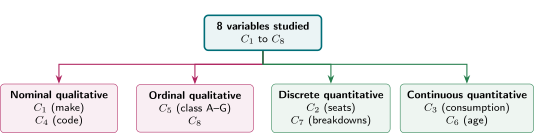
2) Existence of a mean. Only the quantitative variables (, , and ) allow an arithmetic mean to be computed.
3) Limiting case: numerical coding and discretization.
- The regional code is written with digits, but adding two regional codes has no physical or geographic meaning: it is the name of a region disguised as a number, hence a nominal qualitative variable.
- The age is by nature a continuous physical quantity (time). However, if the questionnaire asks only for “the number of full years elapsed” ( years), the continuous measurement is rounded down to the integer below and is treated in practice as a discrete quantitative variable (or as classes of width year).
What the exercise establishes. It is not the use of digits that makes a variable quantitative, but the fact that these digits measure or count a quantity for which addition makes sense.
Similar exercises
- Identifying the population, the individual, the sample and the type of survey solved
- Bounds, widths and midpoints of the classes of a continuous variable solved
- Tallying raw data and building a table of frequencies and relative frequencies solved
- Completing an incomplete statistical table by proportionality solved
- Comparing two populations of different sizes using relative frequencies solved
The course of the chapter · All the exercises of the chapter