Mathematics (Grade 10, Lebanon) · Chapter 11 · Tutorial exercise
Parallelogram, parallelism, midpoint and centroid
Bases and coordinate systems · C. Geometric configurations in a coordinate system and change of origin · level 2
Statement
In the plane equipped with a coordinate system , consider the points , , and .
1) Prove that the points , and are not collinear, and calculate the coordinates of the centroid of the triangle .
2) Find the coordinates of the point such that the quadrilateral is a parallelogram, as well as the coordinates of its center .
3) Prove that the quadrilateral is a parallelogram, and deduce that the point is the midpoint of the segment . Check this result by calculating the coordinates.
Solution
Strategy. We translate each geometric property into its vector equivalent in coordinates: for non-collinearity, for the parallelogram , and for the parallelogram (watch the order of the vertices!).
1) Non-collinearity of and centroid . The vectors and have coordinates: Their determinant is . The vectors and are not collinear, so , and are not collinear and form a genuine triangle. The coordinates of its centroid are:
2) Vertex and center of the parallelogram . The quadrilateral is a parallelogram if and only if . With and , we obtain: The center of the parallelogram is the midpoint of the diagonal :
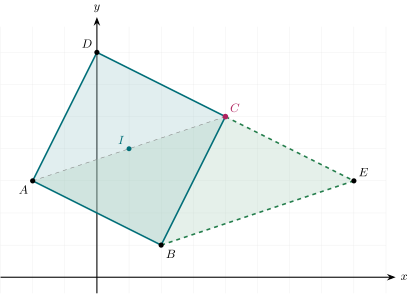
3) Parallelogram and midpoint of . Let us calculate the coordinates of the vector : Since , the quadrilateral is a parallelogram. Therefore, we have both (because is a parallelogram) and , hence : the point is therefore the midpoint of the segment . We check it by the midpoint formula with and :
What the exercise establishes. The order of the letters in the name of a parallelogram dictates the vector equality: parallelogram is translated by , whereas parallelogram is translated by .
Similar exercises
- Linear combinations, determinant and change of basis solved
- Collinearity condition with a parameter and recognizing a basis solved
- Choosing an intrinsic coordinate system attached to a triangle and proving collinearity solved
- Change of origin of the coordinate system and characterization of a central symmetry solved
- Synthesis problem: Land survey of a farming estate in the Akkar plain solved
The course of the chapter · All the exercises of the chapter