Mathematics (Grade 10, Lebanon) · Chapter 11 · Tutorial exercise
Synthesis problem: Land survey of a farming estate in the Akkar plain
Bases and coordinate systems · C. Geometric configurations in a coordinate system and change of origin · level 3 (hard)
Statement
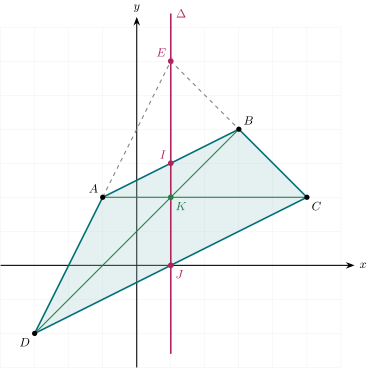
During the land survey of a farm in the Akkar plain, the plane is referred to a coordinate system (with , the unit representing ) whose origin is a water tower. The four boundary markers of the plot are the points:
Part A — Nature of the plot and midpoints of the bases 1) Calculate the coordinates of the vectors and . Deduce that the quadrilateral is a trapezoid with bases and , and state the ratio .
2) Calculate the coordinates of the midpoint of and of the midpoint of .
Part B — Intersection of the non-parallel sides and of the diagonals 3) Let be the point defined by the vector relation .
- a) Calculate the coordinates of the point and justify that belongs to the line .
- b) Calculate the coordinates of the vectors and , prove that the points , and are collinear, and interpret the point geometrically for the trapezoid .
4) Let be the point defined by .
- a) Calculate the coordinates of and justify that belongs to the diagonal .
- b) Prove that the points , and are collinear. What does the point represent for the trapezoid ?
Part C — A remarkable collinearity and harmonic division on the median of the trapezoid 5) Check that the four points , , and all have the same abscissa , and that they therefore belong to the line through with direction vector .
6) We equip the line with the coordinate system of axis . Give the abscissas on the axis of the points , , and , then calculate the algebraic measures , and on this axis and check Descartes' relation:
Solution
Strategy. This problem brings out a fundamental property of trapezoids: the point of intersection of the non-parallel sides, the point of intersection of the diagonals and the midpoints and of the two bases are always collinear, and their positions on the line satisfy the harmonic division relation.
1) Nature of . Let us calculate the coordinates of the vectors and : We notice that : the vectors and are collinear with the same sense, with . The lines and are therefore parallel (and distinct because ): the plot is a trapezoid with bases and , such that .
2) Midpoints and of the two bases. By the midpoint formula:
3) Point of intersection of and .
- a) Denote by the coordinates of . The equality , that is , is translated by: By construction, and are collinear, so belongs to the line (and is the midpoint of ).
- b) We calculate and . The vectors and are collinear, so the points , and are collinear (and is the midpoint of ). Thus, belongs both to and to : it is the point of intersection of the two non-parallel sides of the trapezoid.
4) Point of intersection of the diagonals.
- a) The relation is written in coordinates: Since , the points , and are collinear and .
- b) Let us calculate the coordinates of and : The vectors and are collinear, so . The point belonging both to and to , it is the point of intersection of the diagonals of the trapezoid.
5) Collinearity of and . We found , , and . For each of these four points , we have : the four points therefore all belong to the line through and directed by .
6) Locating points on the axis and Descartes' relation. The equality shows that the abscissa of a point of in the coordinate system of axis is simply its ordinate . On the axis , we therefore have , , and , hence: We then calculate: which exactly checks Descartes' relation on the median of the trapezoid.
What the exercise establishes. In every trapezoid whose bases are in the ratio (here ), the intersection of the non-parallel sides and the intersection of the diagonals divide the corresponding segments in the same ratio , and are collinear with the midpoints and of the two bases.
Similar exercises
- Linear combinations, determinant and change of basis solved
- Collinearity condition with a parameter and recognizing a basis solved
- Parallelogram, parallelism, midpoint and centroid solved
- Choosing an intrinsic coordinate system attached to a triangle and proving collinearity solved
- Change of origin of the coordinate system and characterization of a central symmetry solved
The course of the chapter · All the exercises of the chapter