Mathematics (Grade 10, Lebanon) · Chapter 13 · Tutorial exercise
Synthesis problem: Geodetic triangulation between two coastal headlands in Lebanon
Scalar product · C. Al-Kashi theorem, median theorem, metric relations and level lines · level 3 (hard)
Statement
To determine the distance between two coastal beacons and separated by a rocky bay on the Lebanese coastline, a team of surveyors sets up a theodolite at an observation post located on the shore and records the following measurements: In all computations, the hectometer () is chosen as the unit of length, so that , and .
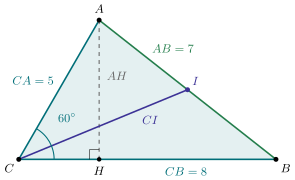
Part A — Solving the sighting triangle 1) Calculate the scalar product and deduce, using the Al-Kashi theorem, the exact distance (in hectometers, then in meters) separating the two beacons and .
2) Calculate the scalar product using the polarization formula in the triangle , and deduce the exact value of .
3) Let be the orthogonal projection of the beacon onto the line of sight . Calculate the exact distances , and the height .
Part B — Midpoint buoy and position circles at sea 4) A marker buoy is moored exactly at the midpoint of the segment . Calculate the exact distance (in hectometers) from the observation post to the buoy .
5) An inspection boat sails in the bay.
- a) Determine and characterize geometrically the set of positions of the plane from which the two beacons and are seen at a right angle (). Does the post belong to ?
- b) Determine the set of positions of the plane such that (in ).
Solution
Strategy. We solve the triangle step by step by combining Al-Kashi, polarization and orthogonal projection onto , then we use the median theorem around the midpoint of to calculate and to determine the level lines of .
1) Scalar product and distance . With , and : By the Al-Kashi theorem applied at the vertex :
2) Scalar product and . In the triangle , the polarization formula at the vertex gives: We immediately deduce:
3) Calculating , and . Since , the orthogonal projection of onto belongs to the ray and satisfies , hence: Since , the point belongs to the segment and (which we recover in the right triangle , where ). Finally, the Pythagorean theorem in , right-angled at , gives:
4) Distance to the midpoint buoy. Since is the midpoint of , the median theorem applied at the vertex gives , that is:
5) Position circles of the boat .
- a) The beacons and are seen from (distinct from and ) at a right angle if and only if . The set is therefore the circle with diameter (without and if a genuine geometric angle is required), that is, the circle with center the buoy and radius . Since , the post does not belong to .
- b) By the second formula of the median theorem: Consequently: The set is the circle with center the buoy and radius .
What the exercise establishes. This problem shows how the scalar product unifies the trigonometry of arbitrary triangles and the geometry of circles: three measurements taken from a single coastal post (, and ) are enough to determine all the distances, heights, medians and level lines of the bay without ever crossing the obstacle.
Similar exercises
- Scalar square, special products and polarization formulas solved
- Two isosceles right triangles constructed on the sides of a triangle solved
- Complete solution of a triangle with Al-Kashi and the median theorem solved
- Metric relations in a right triangle and projections of the foot of the altitude solved
- Level lines and sets of points solved
The course of the chapter · All the exercises of the chapter