Mathematics (Grade 10, Lebanon) · Chapter 14 · Tutorial exercise
Altitudes, perpendicular bisectors, orthocenter, circumscribed circle and Euler line
Analytic form of the scalar product · B. Normal vector, perpendicularity, altitudes and perpendicular bisectors · level 2
Statement
In an orthonormal coordinate system , consider the triangle with vertices , and .
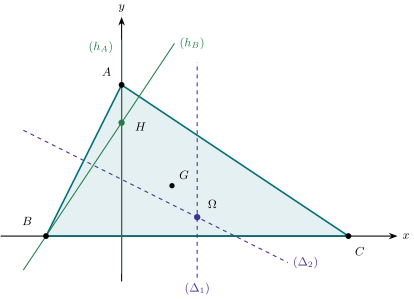
1) Determine a Cartesian equation of the altitude from and of the altitude from , then deduce the coordinates of the orthocenter of the triangle . Check that .
2) Determine a Cartesian equation of the perpendicular bisector of the side and of the perpendicular bisector of the side , then calculate the coordinates of the center and the radius of the circumscribed circle of the triangle .
3) Calculate the coordinates of the centroid of the triangle and check Euler's relation . What can be concluded about the points , and ?
Solution
Strategy. Each altitude passes through a vertex and has the opposite side as a normal vector; each perpendicular bisector passes through the midpoint of a side and has that same side as a normal vector.
1) Altitudes and orthocenter .
- The side lies on the -axis, with normal to . Since , the equation gives (the -axis).
- The altitude passes through and has (or ) as a normal vector:
- The orthocenter satisfies and , hence .
- We check that and have scalar product , so .
2) Perpendicular bisectors, center and radius of the circumscribed circle.
- The midpoint of is and is normal to , so has equation .
- The midpoint of is and (collinear with ) is normal to :
- The center satisfies and , so . The radius of the circumscribed circle is then:
3) Centroid and Euler line. The coordinates of the centroid are: Let us calculate the coordinates of the vectors and : We observe that : the three special points , and are collinear on the Euler line of the triangle .
What the exercise establishes. When a side of the triangle lies on one of the axes of the coordinate system (here on ), the altitude and the perpendicular bisector relative to that side have immediate equations of the form , which halves the work of solving the systems.
Similar exercises
- Scalar product, lengths, nature of a triangle and calculation of angles solved
- Orthogonality with a real parameter and calculation of a remarkable angle solved
- Normal vector, equations of perpendiculars and a family of lines solved
- Orthogonal projection, distance to a line and reflection in a line solved
- Altitude and area of a triangle, and angle bisectors of two intersecting lines solved
The course of the chapter · All the exercises of the chapter