Mathematics (Grade 10, Lebanon) · Chapter 14 · Tutorial exercise
Synthesis problem: Orthogonal connection of a drinking-water reservoir in the Chouf
Analytic form of the scalar product · C. Orthogonal projection, distance from a point to a line and applications · level 3 (hard)
Statement
On the water-supply map of a municipality in the Chouf, referred to an orthonormal coordinate system (unit: ), two straight main pipelines and follow the lines with Cartesian equations: A new reservoir is built at the point .
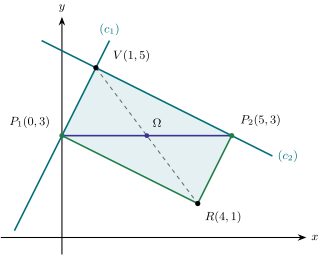
Part A — Valve chamber and minimal connection lengths 1) Prove that the two main pipelines and are perpendicular and calculate the coordinates of their common valve chamber .
2) The reservoir is connected to each of the two pipelines by the shortest possible straight trenches, that is, to the orthogonal projections of onto and of onto .
- a) Without calculating the coordinates of or of , determine the exact lengths and of the two connection trenches.
- b) State the geometric nature of the quadrilateral , and deduce the exact length of a direct link pipeline joining to as well as the area of the quadrilateral .
Part B — Coordinates of the connection points and geometry of the pipeline 3) Determine the Cartesian equations of the lines and , then calculate the exact coordinates of the connection points and .
4) Recover the length from the coordinates of and , and state the direction of the line in the coordinate system .
5) Calculate the scalar product and deduce the exact value of , then determine the center and the radius of the circle through the four points , , and .
Solution
Strategy. Since the two pipelines are perpendicular at , the orthogonal projections and of the reservoir form with and a rectangle : the formula for the distance from a point to a line immediately gives the two sides and of this rectangle even before calculating the coordinates of and .
1) Perpendicularity of and and coordinates of . The respective normal vectors of and are and . In the orthonormal coordinate system: so . The point is the solution of the system: so .
2) Lengths and , rectangle and length .
- a) By definition of the orthogonal projection, and with :
- b) The quadrilateral has three right angles (at since , at and at by orthogonal projection): it is therefore a rectangle. Its diagonals and have the same length, and the Pythagorean theorem in the triangle , right-angled at , gives: The area of the rectangle is ( hectares).
3) Equations of and and coordinates of and .
- Since and , the line is parallel to and passes through : Solving the system formed by and , we obtain and , so .
- Similarly, is parallel to and passes through : Solving the system formed by and , we obtain and , so .
4) Check on . The points and have the same -coordinate : the line is parallel to the -axis (equation ), and the distance is immediately , which confirms the result of question 2b.
5) Angle and circumscribed circle of the rectangle. With and : hence . Finally, the circumscribed circle of the rectangle has the diagonal (or ) as a diameter: its center is the midpoint and its radius is .
What the exercise establishes. When a point is projected orthogonally onto two perpendicular lines and intersecting at , the figure obtained is a rectangle inscribed in the circle with diameter : the formula for the distance from a point to a line then gives the two adjacent sides without any preliminary linear system.
Similar exercises
- Orthogonality with a real parameter and calculation of a remarkable angle solved
- Normal vector, equations of perpendiculars and a family of lines solved
- Altitudes, perpendicular bisectors, orthocenter, circumscribed circle and Euler line solved
- Orthogonal projection, distance to a line and reflection in a line solved
- Altitude and area of a triangle, and angle bisectors of two intersecting lines solved
The course of the chapter · All the exercises of the chapter