Mathematics (Grade 10, Lebanon) · Chapter 15 · Tutorial exercise
Absolute values, geometric interpretation on the real axis and sign condition
First-degree equations in one unknown · C. Absolute values and radicals · level 2
Statement
1) On a graduated line equipped with a coordinate system , consider the points and with respective abscissas and , as well as a moving point with abscissa .
- a) Translate in terms of distances, then solve geometrically and algebraically the two equations and .
- b) We look for the points of the graduated line such that . Translate this relation into an equation with absolute values, solve it in and plot on a figure the points , and the solution positions and .
2) Solve algebraically in the following two equations:
Solution
Strategy. On the real line, can always be written as the distance between and : in particular, . For an equation of the type where the right-hand side depends on without absolute value bars, we first state the compulsory positivity condition .
1) Geometric interpretation and the equation .
- a) Since and , we have and .
- The equation is equivalent to : the solution points are the two points located at distance from , with abscissas and , that is, .
- The equation is equivalent to : on the line , the only point equidistant from and is the midpoint of the segment , with abscissa , that is, .
- b) The condition translates into . Two real numbers have the same absolute value if and only if they are equal or opposite: There are therefore two solution positions on the graduated line: the point located on the segment (with and ) and the point located outside the segment on the side of (with and ).
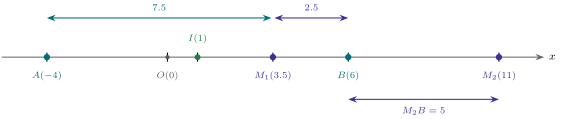
2) Equations of the type .
- For .
- Positivity condition: .
- Solving the two cases: , or .
- Check: since and , both values are kept and .
- For .
- Positivity condition: .
- Solving the two cases: , or .
- Check: neither nor is greater than or equal to (for each of these values, the right-hand side is strictly negative). Both values are therefore rejected and .
What the exercise establishes. To translate into a distance, we must think of the form where has abscissa . Moreover, the comparison between and illustrates why the condition is the decisive filter of every equation .
Similar exercises
- Fractional linear equations, singular cases and discussion according to a parameter solved
- Algebraic factoring, special products and product equations solved
- Quotient equations, reduction to a common denominator and rejection of excluded values solved
- Sum of absolute values and solution by splitting into intervals solved
- Irrational equations that reduce to the first degree solved
The course of the chapter · All the exercises of the chapter