Mathematics (Grade 10, Lebanon) · Chapter 15 · Tutorial exercise
Problem: Geometric and hydraulic layout of a plot in the Bekaa
First-degree equations in one unknown · D. Setting up equations and synthesis problem · level 3 (hard)
Statement
On a farm in the Bekaa plain, a rectangular plot of length and width is laid out, bordered along the side by a water supply channel. A point is chosen on the segment at the distance from the vertex (in meters, with ).
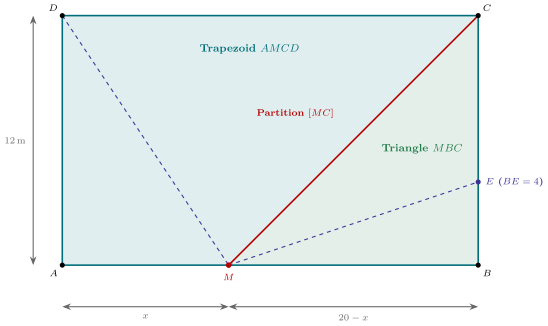
1) Sharing areas by a straight partition . The partition divides the rectangle into a right triangle (settling basin) and a right trapezoid (greenhouse growing area).
- a) Express in terms of the area of the triangle and the area of the trapezoid , then check that for every .
- b) Determine by setting up an equation the value of for which the area of the trapezoid is equal to three times the area of the triangle .
2) Comparing the perimeters of the two areas.
- a) Express in terms of and of the length the perimeter of the triangle and the perimeter of the trapezoid , then show that the difference does not depend on the length .
- b) Determine the position of for which the perimeter of the trapezoid exceeds that of the triangle by , and then calculate the exact value of the length .
3) Positioning a pump strainer equidistant from two inspection chambers. A hydraulic inspection chamber is placed at the vertex and a second inspection chamber is placed at the point of the side located from (). We wish to install the pump strainer at the point of the segment in such a way that it is equidistant from and from ().
- a) Using the Pythagorean theorem in the right triangles and , express the lengths and in terms of .
- b) Solve in the irrational equation and give to within the distance from the strainer to the vertex .
4) Setting the flow rates of two supply valves. Two valves feed the basin according to a setting index : the first valve delivers and the second delivers . We wish to set so that the difference between the flow rates of the two valves is equal to .
- a) Write the rational equation satisfied by , specify its excluded values and solve it in .
- b) Deduce the value of the setting as well as the hourly flow rate of each of the two valves.
Solution
Strategy. Each part of the problem illustrates a family of equations of the lesson: a linear equation coming from a ratio of areas (question 1), algebraic elimination of an unknown common length in a difference of perimeters (question 2), an irrational equation coming from the Pythagorean theorem in which the terms in cancel out (question 3), and a rational equation with factored denominator (question 4).
1) Areas of the triangle and of the trapezoid .
- a) Since with and , we have .
- The triangle is right-angled at with and , so its area equals:
- The right trapezoid has parallel bases and , and height : We do check that .
- b) The condition translates into the first-degree equation: Since , the area of the trapezoid is three times that of the triangle when is the midpoint of (, giving and ).
2) Difference of the perimeters and calculation of .
- a) The perimeter of the triangle and that of the trapezoid read: Subtracting side by side, the common side is eliminated:
- b) The condition is therefore equivalent to . For , we have and : the right triangle is isosceles at , and the Pythagorean theorem gives:
3) Equidistance and irrational equation.
- a) In the triangle right-angled at (, ) and in the triangle right-angled at (, ), the Pythagorean theorem gives:
- b) The two radicands and being strictly positive for every real number , the equation is equivalent on to the equality of the radicands: Since , the strainer must be installed exactly from the vertex .
4) Setting the flow rates of the two valves.
- a) The equation satisfied by is: Since , the excluded values on are and . For every , let us reduce to the common denominator : The numerator vanishes for , which does belong to .
- b) For the setting , the first valve delivers and the second delivers (whose difference does equal ).
What the exercise establishes. This problem shows how geometric or physical situations that seem nonlinear — equality of perimeters with a variable hypotenuse, equality of oblique distances by the Pythagorean theorem, or difference of inversely proportional flow rates — all reduce to a first-degree equation after algebraic simplification.
Similar exercises
- Algebraic factoring, special products and product equations solved
- Quotient equations, reduction to a common denominator and rejection of excluded values solved
- Absolute values, geometric interpretation on the real axis and sign condition solved
- Sum of absolute values and solution by splitting into intervals solved
- Irrational equations that reduce to the first degree solved
The course of the chapter · All the exercises of the chapter