Mathematics (Grade 10, Lebanon) · Chapter 17 · Tutorial exercise
Problem: Optimization of a terraced farm enclosure in the Chouf
General notions on functions · D. Functional modeling and synthesis problem · level 3 (hard)
Statement
On a farming terrace in the Chouf, a farmer has of wire fencing to mark out three sides , and of a rectangular enclosure built against a straight dry-stone wall (the fourth side is formed by the wall and uses no fencing). We denote by the depth of the enclosure perpendicular to the wall (in meters).
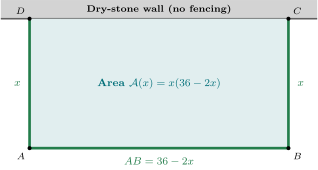
Part A — Maximizing the area of the enclosure.
1) Express the length in terms of , deduce the interval of the possible values of , and show that the area of the enclosure (in ) can be written in the two forms:
2) Calculate the rate of change of the function between two distinct real numbers and of . Study its sign on and on , then draw up the table of variations of on .
3) Determine the value of for which the area of the enclosure is maximal, specify this maximal area as well as the corresponding dimensions and .
4) Using the canonical form of , solve in the equation , then the inequality . Interpret these results concretely.
Part B — Minimizing a maintenance cost index. When the depth belongs to the interval , the daily maintenance of the drainage and of the access paths is modeled by the function defined on by:
5) Prove that, for all distinct real numbers and of , the rate of change of between and is:
6) Study the sign of on and on , draw up the complete table of variations of on , and determine the minimum as well as the maximum of on .
Solution
Strategy. This problem sets side by side the complete study of a second-degree polynomial function (part A, maximizing an area) and that of a rational function of the type (part B, minimizing a cost) by means of the rate of change and of the canonical form.
Part A — Study of the area function .
1) Expression of , domain and forms of . The three fenced sides measure , hence . Since the lengths and must be nonnegative, we have and , that is, . For every : Moreover, expanding , we check the canonical form .
2) Rate of change and table of variations of . For all distinct real numbers and of : hence .
- On : if are distinct, then , so and is strictly increasing on .
- On : if are distinct, then , so and is strictly decreasing on .
| Variations of |
3) Optimal dimensions. From the table of variations (or since ), the area of the enclosure has a maximum equal to , attained for . The optimal dimensions are a depth and a front parallel to the wall (the length is twice the depth).
4) Solving and . Let us use the canonical form:
- .
- .
Concretely, to have an area of at least , the farmer must choose a depth between and .
Part B — Study of the cost index on .
5) Rate of change of . For all distinct real numbers and of : hence .
6) Variations and extrema of on . Since and , the denominator is strictly positive:
- On : for in , we have , so and is strictly decreasing on .
- On : for in , we have , so and is strictly increasing on .
Let us calculate the values at the endpoints and at :
| Variations of |
On , the cost index has a minimum equal to , attained for , and a maximum equal to , attained at the two endpoints and .
What the exercise establishes. This problem illustrates how the study of the sign of the rate of change makes it possible to determine rigorously the extrema of non-monotonic functions — whether it is a parabola with vertex or a function of the form , a sum with a reciprocal term, minimal at .
Similar exercises
- Three forms of a function, images, preimages and intersections with the axes solved
- Graphical readings and algebraic check on a cubic curve solved
- Rate of change and proof of the direction of variation solved
- Algebraic proof of a maximum and a minimum on solved
- Parity, reduction of the domain of study and symmetry of the table of variations solved
The course of the chapter · All the exercises of the chapter