Mathematics (Grade 10, Lebanon) · Chapter 18 · Tutorial exercise
Complete study and representation of a piecewise affine function
Study of functions · A. Affine functions and piecewise affine functions · level 2
Statement
Consider the function defined on by:
1) Determine the zeros of and of , then write without absolute value bars on each of the three intervals , and .
2) Study the direction of variation of on each of these three intervals, draw up its complete table of variations on and specify whether has a minimum or a maximum on .
3) Construct the representative curve in an orthogonal coordinate system , then solve by calculation and check graphically the equation as well as the inequality .
Solution
Strategy. A linear combination of absolute values of affine expressions is a piecewise affine function: on each interval delimited by the zeros and , the sign of the slope of the simplified expression immediately gives the direction of variation of .
1) Writing without absolute value bars. The expression vanishes at and vanishes at . Let us draw up the summary table:
| Interval of | |||
|---|---|---|---|
| Expression of | |||
| Expression of | |||
| Difference |
2) Direction of variation and extrema of .
- On : is affine with slope , so is strictly decreasing. At , .
- On : is linear with slope , so is again strictly decreasing, from to .
- On : is affine with slope , so is strictly increasing starting from .
Overall, is strictly decreasing on and strictly increasing on : it has on a minimum equal to , attained at (and has no maximum on ).
| Variations of |
3) Representative curve and solution of and .
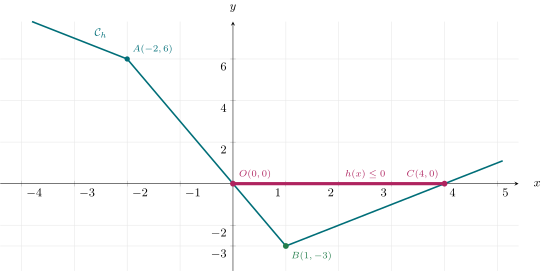
- On : since decreases toward , we have (no solution).
- On : , and , which gives the segment .
- On : , and , which gives the segment .
In conclusion: the equation has solution set , and the inequality has as solution set the interval .
What the exercise establishes. To draw a piecewise affine function without error, we first plot the corner points and where the absolute values vanish, then one additional point on each of the two outer rays.
Similar exercises
- Determining two affine functions, intersection of lines and sign of a product solved
- Equations, inequalities and bounds with the square function solved
- Study of a second-degree function from its canonical form solved
- Study of a function with a square root and conjugate quantity solved
- Comparison of , and and subadditive inequality of the square root solved
The course of the chapter · All the exercises of the chapter