Mathematics (Grade 10, Lebanon) · Chapter 19 · Tutorial exercise
Complete reading on a curve, sign table and discussion according to
Graphical solution of equations and inequalities · B. Graphical reading of equations and inequalities, and parametric discussion · level 2
Statement
Consider the function defined on the interval by , whose representative curve is drawn below:
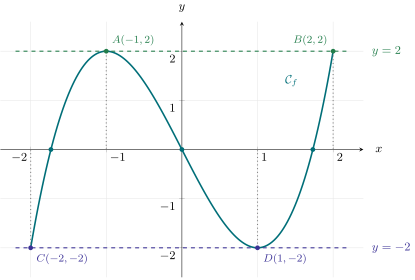
1) Solve graphically on the equations and , then prove these results by calculation after checking that, for every real number , and .
2) Determine by calculation the exact values of the solutions of in , then draw up the sign table of on using the graph and deduce the solution set of the inequality .
3) Solve graphically on the inequalities and .
4) Discuss graphically, according to the values of the real number , the number of solutions in of the equation .
Solution
Strategy. For each equation (or inequality ), we examine the points of intersection (or the position) of relative to the horizontal line , taking care with the points of tangency and where the curve touches the line without crossing it.
1) Solving and .
- Graphically, the horizontal line touches at the peak and meets it at the point : the equation therefore has solution set . By calculation, let us expand : Thus or .
- Similarly, the line passes through and touches at the local minimum , that is, . By calculation, , which does vanish only at and .
2) Zeros and sign table of on . Factoring out : which all three belong to since . Reading on the graph on which intervals is located above or below the axis , we obtain the sign table: The inequality therefore has solution set .
3) Graphical solution of and of .
- On , the whole curve is located below or on the line ; the strict inequality excludes only the two abscissas where (namely and ):
- No point of on is located strictly below the line , and only the points and belong to this line: the inequality therefore reduces to the two isolated values .
4) Discussion of the number of solutions of on . Letting the horizontal line sweep from to :
- if or if , the line does not meet : no solution;
- if or if , the line meets at two points (one of which is a point of tangency): exactly two solutions;
- if , the line cuts each of the three monotonic branches of : exactly three distinct solutions.
What the exercise establishes. When a curve stays below a horizontal line while touching it at a point with abscissa , the strict inequality requires removing the isolated value from the solution interval, whereas the non-strict inequality at the level of the absolute minimum gives only a finite set of numbers.
Similar exercises
- Equality or mere coincidence of two functions: role of the domain of definition solved
- Solving second-degree equations and inequalities by means of the parabola solved
- Irrational equations and inequalities by means of the half-parabola solved
- Equations, inequalities and discussion with the absolute value function solved
- Relative position of a hyperbola and a line by the sign of the difference solved
The course of the chapter · All the exercises of the chapter