Mathematics (Grade 10, Lebanon) · Chapter 19 · Tutorial exercise
Graphical and algebraic study of the profitability of a cabinetmaking workshop in Tripoli
Graphical solution of equations and inequalities · C. Graphical solution by means of the usual functions and relative positions · level 3 (hard)
Statement
A craft cabinetmaking workshop in Tripoli makes each week between and cedar-wood bookcases. For (where models the weekly production), the total manufacturing cost (expressed in hundreds of dollars) is given by the function: Each bookcase made is sold for dollars (that is, hundreds of dollars); the weekly revenue (in hundreds of dollars) is therefore modeled on by the linear function:
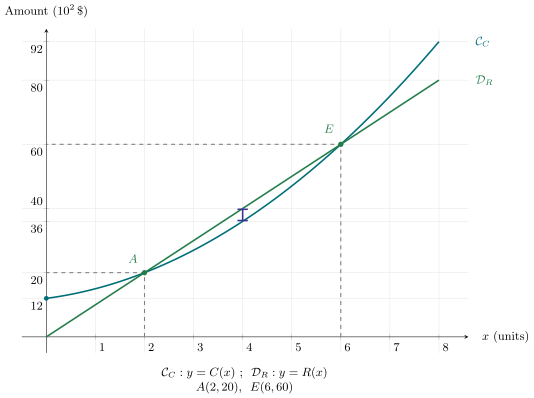
Part A — Graphical reading and profitability zone. 1) What does the value represent concretely? Read graphically the manufacturing cost and the revenue for bookcases and specify whether the workshop is then making a profit or a loss. 2) We call break-even points the production levels for which the revenue is exactly equal to the total cost (), and profitability range the set of values of for which the workshop makes a nonnegative profit (). Read graphically the abscissas of the break-even points and as well as the profitability range.
Part B — Algebraic proof and maximum profit. 3) The weekly profit (in hundreds of dollars) is defined on by .
- a) Check that, for every , we have the three equivalent forms:
- b) Using the factored form of , draw up the sign table of on and prove the results read in question 2.
- c) Using the canonical form , prove that the weekly profit has a maximum on , specifying its value (in dollars) and the corresponding number of bookcases. How can this maximum be seen on the graph between the curves and ?
4) Solve by calculation in the inequality and interpret this result for the workshop.
Part C — Study of the average unit cost. 5) For every , we define the average cost of making one bookcase by . The workshop wishes this average unit cost not to exceed dollars (that is, hundreds of dollars).
- a) Show that the inequality on is equivalent to .
- b) Solve this inequality on and conclude.
Solution
Strategy. This problem illustrates how graphical reading and algebraic proof complement each other:
- the position of the revenue line above the cost parabola expresses visually the profitability ;
- the three algebraic forms of the profit each answer a specific question: the factored form gives the profitability thresholds (), and the canonical form gives the maximum profit and the thresholds of guaranteed profit ().
Part A — Graphical reading and profitability zone.
1) Fixed costs and situation for .
- The value (that is, dollars) represents the weekly fixed costs of the workshop (rent, maintenance, insurance), borne even when the production is zero.
- For , we read on the ordinate (that is, dollars of cost) and on the ordinate (that is, dollars of revenue). Since ( is above ), the workshop is making a profit and earns a gain of hundreds of dollars, that is, dollars.
2) Break-even points and profitability range.
- The curves and meet at the points and : the two break-even points therefore correspond to a production of bookcases and of bookcases.
- The inequality holds when the line is located above the parabola , that is, on the interval .
Part B — Algebraic proof and maximum profit.
3) Three forms of , sign table and maximum.
- a) For every : On the one hand, . On the other hand, factoring the difference of two squares :
- b) Let us draw up the sign table of the product on : We thus recover that (break-even points) and that (profitability range).
- c) For every , we have , so and: with equality if and only if , that is, . The maximum weekly profit is therefore hundreds of dollars, that is, dollars, attained for bookcases made and sold. Graphically, this maximum corresponds to the abscissa where the vertical gap (segment with arrows in the figure) between the line (above) and the parabola (below) is the greatest.
4) Threshold of a profit of at least dollars (). Using the canonical form: This product is nonnegative on : the workshop makes at least dollars of weekly profit when it produces between and bookcases.
Part C — Study of the average unit cost.
5) Solving on .
- a) For every : Now , hence the equivalence with .
- b) On , the denominator is strictly positive (). The quotient therefore has the sign of the numerator , which is nonpositive if and only if . The average unit cost is therefore less than or equal to dollars when the workshop makes or bookcases per week.
What the problem establishes. Comparing a revenue and a cost on a graph amounts to studying the relative position of their curves, whereas moving to the difference function in its expanded, canonical and factored forms makes it possible to solve algebraically all the questions of break-even, optimization and threshold.
Similar exercises
- Complete reading on a curve, sign table and discussion according to solved
- Solving second-degree equations and inequalities by means of the parabola solved
- Irrational equations and inequalities by means of the half-parabola solved
- Equations, inequalities and discussion with the absolute value function solved
- Relative position of a hyperbola and a line by the sign of the difference solved
The course of the chapter · All the exercises of the chapter