Mathematics (Grade 10, Lebanon) · Chapter 19 · Tutorial exercise
Irrational equations and inequalities by means of the half-parabola
Graphical solution of equations and inequalities · C. Graphical solution by means of the usual functions and relative positions · level 2
Statement
In an orthogonal coordinate system, consider on the curve of the square root function , the line with equation and the line with equation .
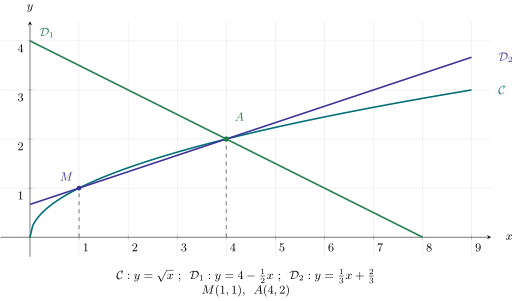
1) Solve graphically on the equation and the inequality . Justify by means of the direction of variation of the two functions why the equation cannot have any other solution on .
2) Show that the equation and the inequality reduce to the relative position of and , then solve them graphically.
3) Check that, for every real number , we have , and prove algebraically the results of the previous question.
Solution
Strategy. We never forget that the domain of definition of is : any solution set of an inequality that includes the left part of the curve therefore necessarily begins at (and not at ).
1) Intersection and comparison with .
- On the graph, the half-parabola and the line meet at the point (and we check that and ).
- On , the function is strictly increasing whereas the affine function is strictly decreasing: the difference is therefore strictly increasing on . Since , the abscissa is the unique solution of the equation on .
- On , is located below (that is, ): the inequality therefore has as solution set the bounded interval .
2) Graphical solution of and of . Dividing both sides by , we get: The line meets the curve at the two points and , and the arc of is located above the chord between the abscissas and . We therefore read:
3) Algebraic proof. For every real number , let us expand the product using : Thus:
- or or ;
- . Now, since the square root function is strictly increasing on , the factor is negative on and positive on , whereas is negative on and positive on . Their product is therefore nonpositive if and only if .
What the exercise establishes. Letting (with ) transforms an equation or inequality of the form into a second-degree trinomial in , whose factorization confirms exactly the intersection of the half-parabola with a line.
Similar exercises
- Complete reading on a curve, sign table and discussion according to solved
- Solving second-degree equations and inequalities by means of the parabola solved
- Equations, inequalities and discussion with the absolute value function solved
- Relative position of a hyperbola and a line by the sign of the difference solved
- Graphical and algebraic study of the profitability of a cabinetmaking workshop in Tripoli solved
The course of the chapter · All the exercises of the chapter