Mathematics (Grade 10, Lebanon) · Chapter 20 · Tutorial exercise
Constructions without a graduated ruler by the preserved properties, and visibility in a cube
Plane representation of solids · A. Rules of cavalier perspective and preserved properties · level 2
Statement
Let be a cube with real edge represented in cavalier perspective (the front face , the top face and the right face being the three visible faces). We denote by the center of the bottom square , the center of the top square , the midpoint of and the centroid of the triangle .
1) Explain how to construct geometrically, on the drawing in cavalier perspective, the points , and using only an ungraduated ruler, citing the properties of cavalier perspective that are used.
2) Specify, with justification, which of the six segments , , , , and must be drawn as solid lines and which must be drawn as dashed lines.
3) Calculate in space the exact lengths of the segments , and , and prove that the triangle is right-angled at in reality. Is it represented by a right triangle in the drawing?
Solution
Strategy. Since cavalier perspective preserves collinearity and midpoints, it preserves the intersection of the diagonals of a parallelogram and the intersection of the medians of a triangle. For visibility, a segment is a solid line only if it is entirely drawn on one of the three visible faces (, or ).
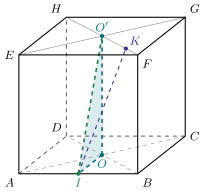
1) Geometric construction of , and without measuring.
- In space, the center of the square is the common midpoint of the diagonals and . Since cavalier perspective preserves collinearity and midpoints, is simply the point of intersection of the segments and drawn in the drawing.
- Similarly, is obtained by drawing the intersection of the diagonals and of the top face .
- In the triangle , the point is the midpoint of the side , so the segment is the median from . Joining likewise to the midpoint of (or using a second median), their point of intersection in the drawing gives exactly the centroid of the triangle (located one third of the way along from ).
2) Visibility of the six segments.
- and are entirely contained in the visible top face : they are drawn as solid lines.
- is contained in the bottom face , which is hidden by the cube: it is drawn as a dashed line.
- , and cross the interior of the cube (because their endpoints do not belong to any common face of the cube): all three are drawn as dashed lines.
3) Calculating the real lengths and nature of .
- In the square of side , is the midpoint of and is the midpoint of : by the midpoint theorem in the triangle , the line is parallel to and:
- The segment joins the centers of the two opposite bases: it is parallel to the vertical edge , perpendicular to the plane , and of length .
- Since is perpendicular to the plane , it is perpendicular to the line contained in this plane: the triangle is therefore right-angled at in space. By the Pythagorean theorem: In the drawing, is vertical whereas is parallel to the receding line (which makes the angle with the horizontal): the angle in the drawing equals , so does not appear right-angled in the drawing.
What the exercise establishes. All the barycentric constructions (midpoint, center of a parallelogram, centroid of a triangle) are carried out directly on the drawing in cavalier perspective by simple intersections of lines, whereas the calculations of lengths are carried out in space by the Pythagorean theorem.
Similar exercises
- Calculating lengths, angles and an area on a rectangular prism in cavalier perspective solved
- Right prism with an isosceles triangular base: perspective, net, areas and volume solved
- Regular pyramid with a hexagonal base: apothem, lateral edge, area and volume solved
- From the net to the right circular cone: radius, height, apex angle and volume solved
- Cube truncated at a corner: representation, area of the cut face and distance from a vertex to the plane solved
The course of the chapter · All the exercises of the chapter