Mathematics (Grade 10, Lebanon) · Chapter 20 · Direct application of the course
Critical reading of a figure in cavalier perspective
Plane representation of solids · level 2
Statement
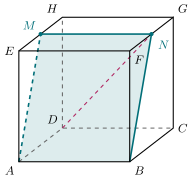
Let be a cube with edge represented in cavalier perspective. We denote by the midpoint of and by the midpoint of .
- An observer states, looking at the drawing, that the lines and are not perpendicular. Is the observer right in space? Explain the origin of the error.
- Specify, with justification, which lines must be drawn as solid lines and which lines must be drawn as dashed lines among the segments , , and (when the cube is seen from the front, from above and from the right, the face being in the foreground).
- What is the real nature of the quadrilateral ? Calculate its real length and the real area of .
Solution
- The observer is wrong: in space, the face of a cube is a square, so the edges and are perpendicular ( in reality). In the drawing, is vertical and is a receding line making the angle with the horizontal: the drawn angle equals (or ), because cavalier perspective does not preserve orthogonality outside the frontal planes.
- With the face at the front, the top face and the right face are visible, whereas the left face and the back face are hidden:
- is drawn on the visible top face : it is a solid line;
- is drawn on the visible right lateral face : it is a solid line;
- is drawn on the hidden left lateral face (whose edge is hidden): it is a dashed line;
- crosses the interior of the cube to join the hidden vertex to the point : it is a dashed line.
- In space, and being the respective midpoints of and in the square , the segment is parallel to and of the same length, so and . The quadrilateral is therefore a parallelogram. Moreover, the edge is perpendicular to the face , hence perpendicular to the line contained in this face: is a rectangle. In the triangle right-angled at (with and ), the Pythagorean theorem gives:
The real area of the rectangle therefore equals:
Similar exercises
- Cube truncated at a corner: representation, area of the cut face and distance from a vertex to the plane solved
- Geometric study and capacity of a cylindrical-conical grain silo in the Bekaa plain solved
- Calculating lengths and angles in cavalier perspective solved
- Representation and study of a regular tetrahedron solved
- Net and volume of a right circular cone solved
The course of the chapter · All the exercises of the chapter