Mathematics (Grade 10, Lebanon) · Chapter 20 · Tutorial exercise
Cube truncated at a corner: representation, area of the cut face and distance from a vertex to the plane
Plane representation of solids · C. Solids of revolution and truncated solids · level 2
Statement
In a cube with edge , consider the respective midpoints , and of the three edges , and from the vertex . We saw the cube along the plane in order to remove the tetrahedron .
1) Represent in cavalier perspective the cube and the tetrahedron , respecting the visibility conventions.
2) Determine the exact nature of the triangle in space, calculate the exact length of its sides and show that its area equals .
3) Considering the tetrahedron as a pyramid whose base is the right triangle and whose height is , calculate the volume of the corner removed and the volume of the remaining solid. Expressing in a second way with the base , deduce the exact distance from the vertex to the cutting plane .
Solution
Strategy. The tetrahedron is trirectangular at (its three edges , , from are pairwise perpendicular and of the same length ). The method of calculating the volume in two ways () then gives the height from without having to construct the orthogonal projection of onto .
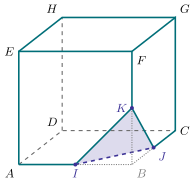
1) Representation in cavalier perspective. The segments (on the front face ) and (on the right face ) are on visible faces and are drawn as solid lines, whereas (on the bottom face ) is drawn as a dashed line.
2) Nature and area of the cut face . The three triangles , and are isosceles right triangles with the right angle at , with . By the Pythagorean theorem: The triangle has its three sides equal to : it is an equilateral triangle. Its altitude measures and its area equals:
3) Volume of the corner removed, remaining volume and distance from to the plane .
- Taking as base the triangle right-angled at (with area ) and as height the edge perpendicular to the plane (), the volume of the tetrahedron is: The volume of the solid remaining after cutting is therefore .
- On the other hand, taking the triangle as the base of the tetrahedron , the corresponding height is the distance from the vertex to the plane : hence .
What the exercise establishes. Expressing the volume of the same tetrahedron by changing the base face () is the best method for calculating the distance from a vertex to a cutting plane.
Similar exercises
- Constructions without a graduated ruler by the preserved properties, and visibility in a cube solved
- Right prism with an isosceles triangular base: perspective, net, areas and volume solved
- Regular pyramid with a hexagonal base: apothem, lateral edge, area and volume solved
- From the net to the right circular cone: radius, height, apex angle and volume solved
- Geometric study and capacity of a cylindrical-conical grain silo in the Bekaa plain solved
The course of the chapter · All the exercises of the chapter