Mathematics (Grade 10, Lebanon) · Chapter 20 · Tutorial exercise
Geometric study and capacity of a cylindrical-conical grain silo in the Bekaa plain
Plane representation of solids · C. Solids of revolution and truncated solids · level 3 (hard)
Statement
A grain cooperative in the Bekaa plain is having a metal silo built, standing on a horizontal slab. This silo consists of:
- a lower part in the shape of a right circular cylinder with vertical axis , base radius and height ;
- a roof in the shape of a right circular cone with apex , the same vertical axis , the same base disk with center and radius , and height .
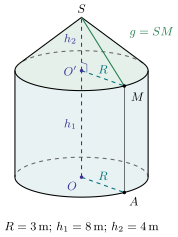
Part A — Geometry of the silo and plane representation. 1) What is the total height of the silo? By which geometric figure is each of the two horizontal circles with centers and represented on the drawing in cavalier perspective, and why are the back arcs drawn as dashed lines? 2) Let be a point of the junction circle with center and let be the point located vertically below on the base circle with center .
- a) Calculate the length of the generatrix of the conical roof.
- b) What is the nature of the quadrilateral in the meridian plane ? Calculate the real distance between the apex of the roof and the lower edge of the silo.
Part B — Net of the roof and outer surface to be painted. 3) To make the conical roof, a metalworker cuts out a circular sector of radius and central angle (in degrees). Calculate the exact value of . 4) We wish to apply an anticorrosion paint on the whole visible outer wall of the silo (lateral surface of the cylinder and lateral surface of the conical roof, without painting the base disk resting on the slab).
- a) Calculate the exact value (in terms of ), then the approximate value to the nearest tenth of a , of the total outer area to be painted.
- b) Knowing that one can of paint covers and that two coats are applied, how many cans must be ordered at least?
Part C — Volume of the silo and gauging the wheat. 5) Calculate the exact values (in terms of ) of the volume of the cylindrical part, of the volume of the conical roof and of the total volume of the silo, as well as an approximate value to the nearest tenth of a of . 6) The stored wheat forms a cylindrical column of height (in meters) in the lower part of the silo.
- a) Express the volume of wheat (in ) in terms of and .
- b) To what height does the wheat rise when the silo contains a volume of wheat equal to two thirds of its total volume ?
Solution
Strategy. We extract the meridian half-plane containing the vertical axis and the points and : in this plane, the rectangle is topped by the right triangle , which reduces all the calculations of lengths to the Pythagorean theorem, before applying the formulas for the areas and volumes of the right circular cylinder and cone.
Part A — Geometry of the silo and plane representation.
1) Total height and reading the perspective.
- The total height of the silo is .
- The horizontal circles with centers and are not located in frontal planes: in cavalier perspective, they are therefore represented by ellipses with centers and . The silo being opaque, the back half-ellipses are hidden by the front wall and are drawn as dashed lines.
2) Calculating the generatrix and the distance .
- a) In the triangle right-angled at (with and ), the Pythagorean theorem gives:
- b) In the meridian half-plane, the radii and are perpendicular to the axis and of the same length : the quadrilateral is a rectangle with sides and . In the large triangle right-angled at (with and ), the Pythagorean theorem gives:
Part B — Net of the roof and outer surface to be painted.
3) Central angle of the net of the conical roof. The length of the arc of the circular sector of radius must be equal to the perimeter of the base circle:
4) Outer area to be painted and number of cans.
- a) The outer area to be painted is the sum of the lateral surface area of the cylinder and the lateral surface area of the cone:
- b) For two coats, the total surface to be covered is . The quotient by equals : at least cans of paint must therefore be ordered.
Part C — Volume of the silo and gauging the wheat.
5) Exact volumes and approximate value.
- Volume of the cylinder: .
- Volume of the cone: .
- Total volume of the silo: .
6) Height of wheat for a filling to two thirds of the total volume.
- a) For , the wheat occupies a cylinder of radius and height , that is:
- b) Two thirds of the total volume of the silo represent (which is indeed less than the maximum volume of the cylindrical part). We solve:
What the problem establishes. The study of a composite solid (cylinder topped by a cone) rests on extracting the meridian half-plane for the calculations of lengths by Pythagoras, and on adding only the lateral surfaces for the outer area (the common junction disk with center being inside the solid).
Similar exercises
- Constructions without a graduated ruler by the preserved properties, and visibility in a cube solved
- Right prism with an isosceles triangular base: perspective, net, areas and volume solved
- Regular pyramid with a hexagonal base: apothem, lateral edge, area and volume solved
- From the net to the right circular cone: radius, height, apex angle and volume solved
- Cube truncated at a corner: representation, area of the cut face and distance from a vertex to the plane solved
The course of the chapter · All the exercises of the chapter