Mathematics (Grade 10, Lebanon) · Chapter 20 · Direct application of the course
Representation and study of a regular tetrahedron
Plane representation of solids · level 2
Statement
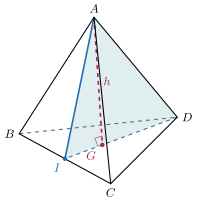
Let be a regular tetrahedron with edge . We denote by the midpoint of the edge and by the centroid of the equilateral triangle , foot of the altitude from .
- Calculate in true size the lengths , and , then deduce the height and the volume of the tetrahedron.
- Is the triangle isosceles? Is it equilateral? Calculate .
- Represent the tetrahedron , the segments , and the height in cavalier perspective, respecting the visibility conventions.
Solution
- The faces and are equilateral triangles of side . In an equilateral triangle of side , the median-altitude measures , so:
The centroid of the triangle is located two thirds of the way along the median from , hence:
The line being perpendicular to the plane , the triangle is right-angled at . By the Pythagorean theorem:
The area of the base equals . The volume of the tetrahedron is therefore:
- In the triangle , we have and : the triangle is isosceles at , but not equilateral. In the triangle right-angled at , we have:
- In the representation in cavalier perspective (where is the hidden back edge), the segment is on the visible front left face , hence a solid line; the segment is on the hidden bottom face and is inside the tetrahedron: both are drawn as dashed lines.
Similar exercises
- Cube truncated at a corner: representation, area of the cut face and distance from a vertex to the plane solved
- Geometric study and capacity of a cylindrical-conical grain silo in the Bekaa plain solved
- Calculating lengths and angles in cavalier perspective solved
- Critical reading of a figure in cavalier perspective solved
- Net and volume of a right circular cone solved
The course of the chapter · All the exercises of the chapter