Mathematics (Grade 10, Lebanon) · Chapter 20 · Tutorial exercise
Right prism with an isosceles triangular base: perspective, net, areas and volume
Plane representation of solids · B. Common polyhedra · level 2
Statement
Consider a right prism of height , whose parallel bases and are triangles isosceles at (and at ) such that and . We denote by the midpoint of and by the midpoint of .
1) Prove that is perpendicular to , calculate the real length , then deduce the area of the base , the lateral surface area , the total surface area and the volume of the right prism.
2) We represent this prism in cavalier perspective by placing the rectangular face in the frontal plane and taking the line (perpendicular to the frontal plane ) as a receding line, with a receding angle and a reduction ratio . Calculate the length of in the drawing and draw the prism in cavalier perspective as well as its net.
3) Calculate in space the exact lengths of the segments and .
Solution
Strategy. To represent in cavalier perspective a non-right triangle located in a plane perpendicular to the frontal plane , we use the foot of its altitude : the segment is frontal (in true size) and the altitude , perpendicular to , is carried by a receding line!
1) Altitude , areas and volume of the prism. In the triangle isosceles at , the median from the apex is also the altitude relative to : so , with . By the Pythagorean theorem in the triangle right-angled at : We deduce:
- Area of a base: .
- Perimeter of the base and lateral surface area: , hence .
- Total surface area: .
- Volume: .
2) Representation in cavalier perspective and net. The face is a frontal rectangle of width and height . From the midpoint of (and from the midpoint of ), we draw a receding line at on which we mark off the reduced length:
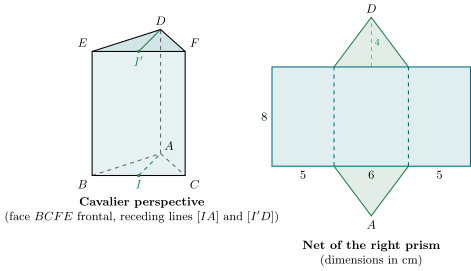
3) Real lengths of and . The lateral faces and of a right prism are rectangles with sides and . Their diagonals and therefore have the same real length:
What the exercise establishes. When a figure does not have two perpendicular sides, we rely on the pair formed by a side and the perpendicular altitude to construct the figure in cavalier perspective by means of a receding line.
Similar exercises
- Calculating lengths, angles and an area on a rectangular prism in cavalier perspective solved
- Constructions without a graduated ruler by the preserved properties, and visibility in a cube solved
- Regular pyramid with a hexagonal base: apothem, lateral edge, area and volume solved
- From the net to the right circular cone: radius, height, apex angle and volume solved
- Cube truncated at a corner: representation, area of the cut face and distance from a vertex to the plane solved
The course of the chapter · All the exercises of the chapter