Mathematics (Grade 10, Lebanon) · Chapter 22 · Tutorial exercise
Four-sided roof frame (hip roof) of a traditional house in Mount Lebanon
Lines and planes – Relative positions · C. Construction of plane sections by means of parallelism · level 3 (hard)
Statement
A traditional dressed-stone house in Mount Lebanon is covered by a hip roof with four plane faces of red tiles:
- the base of the roof is a horizontal rectangle with length and width ;
- the upper ridge is a segment with length , placed horizontally at the height above the plane in the perpendicular bisector plane of the sides and ;
- more precisely, if we denote by the midpoint of , the midpoint of , and the respective orthogonal projections of and on the plane , the points are collinear in this order on the perpendicular bisector of and (with ), such that: The roof is made up of two large isosceles trapezoidal faces and , and of two lateral isosceles triangular faces (called hips) and .
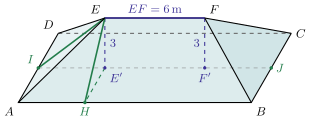
Part A — Parallelism and roof theorem. 1) Prove that the quadrilateral is a rectangle, that the ridge line is parallel to the plane , and explain by means of the roof theorem why the ridge edge is necessarily parallel to the eave walls and . 2) In the vertical median plane , the lines and are not parallel and intersect at a point located above the ridge. Prove by means of the roof theorem that the planes of the two triangular hips and intersect along a line passing through whose direction is to be specified, and calculate the height of above the plane .
Part B — Extraction of plane figures and total area of the roof. 3) By extracting the right triangle , calculate the length (altitude of the isosceles triangle relative to ), then deduce the area of each of the two triangular hips and . 4) We denote by the orthogonal projection of on (so that and ).
- a) By extracting the right triangle , calculate the length (slant height of the trapezoidal face ), then the length of a hip rafter in the triangle , right-angled at .
- b) Calculate the area of each of the two trapezoidal faces and , then the total area of the roof.
Part C — Volume of the attic under the roof frame. 5) By cutting the attic by the two vertical planes passing through and and parallel to , we decompose the solid into a central right prism with a triangular base (with height ) and two lateral pyramids with a rectangular base, with apex and apex . Calculate the total volume of the attic under the roof.
Solution
Strategy. This problem stages the very architectural origin of the roof theorem: the two pairs of parallel opposite sides of the rectangular base govern the lines of intersection of the two large trapezoidal faces on the one hand, and of the two triangular hips on the other hand. The vertical right triangles and then provide the slopes and the areas in true size.
Part A — Parallelism and roof theorem.
1) Rectangle , parallelism of with and roof theorem.
- The segments and are both perpendicular to the plane and of the same length : they are therefore parallel, equal and perpendicular to , which proves that is a rectangle.
- In particular, . Since is contained in the plane , the parallelism criterion ensures that .
- The two planes of the front face and of the back face intersect along the ridge line and contain respectively the lines and , which are parallel (opposite sides of the rectangle ): by the roof theorem, their line of intersection is parallel to and to .
2) Line of intersection and height of the point .
- The point belongs to and to : the two planes and therefore intersect along a line passing through .
- But the plane contains the line and the plane contains the line , with . By the roof theorem, their line of intersection is the line passing through and parallel to and to .
- In the median plane , the triangle is isosceles at with base , and the segment (with length , parallel to ) is located at the height above . Denoting by the height of above , Thales' theorem gives:
Part B — Extraction of plane figures and total area of the roof.
3) Altitude and area of the triangular hips and . In the triangle , right-angled at , we have and . By the Pythagorean theorem: By symmetry with respect to the perpendicular bisector plane , we have , so is the altitude of the isosceles triangle relative to the base . The area of each of the two hips is:
4) Slant height , hip rafter and total area of the roof.
- a) In the rectangle , is the midpoint of (), so the projection of on forms a square with side , hence and . In the triangle , right-angled at (with and ), the Pythagorean theorem gives the slant height of the trapezoidal face : In the triangle , right-angled at (on the face ), the hip rafter measures:
- b) The face is an isosceles trapezoid with long base , short base and height : The total area of the roof is therefore:
Part C — Volume of the attic under the roof frame.
5) Decomposition into a right prism and two pyramids.
- The central part is a right prism whose base is an isosceles triangle with base and height (area ) and whose length (height of the prism) is :
- Each of the two lateral parts is a pyramid with height and whose base is a rectangle with sides and (area ): The total volume of the attic is therefore:
What the problem establishes. The roof theorem explains geometrically why the ridge lines of a roof resting on parallel walls are themselves parallel to these walls, while cutting by vertical planes reduces the calculation of the slopes, of the tile surfaces and of the volume of a hip roof to -- right triangles, trapezoids, a right prism and two pyramids.
Similar exercises
- Parallel planes in a cube and section by a plane parallel to two lines solved
- The roof theorem in a tetrahedron: line of intersection and point of concurrence solved
- Varignon's theorem in space, bimedians of a tetrahedron and rhombus conditions solved
- Section of a regular pyramid by a plane parallel to two edges solved
- Section of a cube using the parallelism of opposite faces solved
The course of the chapter · All the exercises of the chapter