Mathematics (Grade 10, Lebanon) · Chapter 22 · Tutorial exercise
Parallel planes in a cube and section by a plane parallel to two lines
Lines and planes – Relative positions · A. Relative positions of lines and planes and parallelism criteria · level 2
Statement
Let be a cube with edge . We denote by the respective midpoints of the three edges , and coming from the vertex , and by the respective midpoints of the three edges , and coming from the opposite vertex .
1) Prove that the planes and are parallel, and that the same holds for the planes and . What can be deduced for the planes and ?
2) Consider the unique plane passing through the midpoint of and parallel to the plane . Using the intersection of the plane with the faces of the cube (which cut along the lines , and ) or with the parallel plane , determine the intersection of with each of the six faces of the cube and show that the section obtained is a regular hexagon with side .
Solution
Strategy. We first apply the midpoint theorem in the faces of the cube to establish the parallelism of pairs of intersecting lines, then the transitivity of the parallelism of planes. To construct the section by the plane parallel to , we use the fundamental theorem: if two planes and are parallel, any face plane that cuts along a line cuts along a line parallel to .
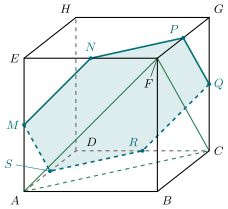
1) Parallelism of the planes , and .
- In the triangles and , the midpoint theorem gives and . The plane therefore contains two lines intersecting at , and , respectively parallel to the two lines of the plane intersecting at , and : thus .
- In the triangles and , the midpoint theorem gives and . But, in the diagonal rectangle , we have , and in the parallelogram , we have . By transitivity, and . Since the two intersecting lines and of are parallel to two intersecting lines of , we have .
- By transitivity of the parallelism of planes, since and , we conclude that .
2) Hexagonal section by the plane passing through and parallel to . Since , every plane that cuts cuts along a parallel line:
- the plane cuts along and contains (midpoint of ): it therefore cuts along the parallel to passing through . In the triangle , the midline coming from cuts at its midpoint ;
- the plane is parallel to , which cuts along : therefore cuts along the parallel to (and hence to ) passing through , which cuts at its midpoint ;
- the plane cuts along and contains : it cuts along the parallel to (and hence to ) passing through , which cuts at its midpoint ;
- step by step on the three remaining faces , and , the traces parallel to , and pass through the midpoints of and of before returning to . In each square face with side , the side of the section is the hypotenuse of an isosceles right triangle with legs and , so: Moreover, the six vertices are all located at the same distance from the center of the cube (which is the midpoint of , and ): the section is therefore a regular hexagon with side .
What the exercise establishes. In a cube, the planes perpendicular to a space diagonal give successively, when they are translated from to , an equilateral triangle , the large equilateral triangle , the regular hexagon of the midpoints at the center , the large equilateral triangle (the image of under the point reflection with center ), then the equilateral triangle .
Similar exercises
- Relative positions of lines and planes in a right prism with a triangular base solved
- The roof theorem in a tetrahedron: line of intersection and point of concurrence solved
- Varignon's theorem in space, bimedians of a tetrahedron and rhombus conditions solved
- Section of a regular pyramid by a plane parallel to two edges solved
- Section of a cube using the parallelism of opposite faces solved
The course of the chapter · All the exercises of the chapter