Mathematics (Grade 10, Lebanon) · Chapter 22 · Tutorial exercise
Section of a regular pyramid by a plane parallel to two edges
Lines and planes – Relative positions · C. Construction of plane sections by means of parallelism · level 2
Statement
Let be a regular pyramid with a square base with side and whose four lateral edges also measure (the four lateral faces are therefore equilateral triangles with side ). On the edge , we place the point such that (and therefore ). We cut the pyramid by the plane passing through and parallel both to the base edge and to the lateral edge .
1) Construct step by step the traces of the plane on the base and on the lateral faces , and , justifying each parallel drawn by means of the theorems of the course. We denote by , and the respective points of intersection of with the edges , and .
2) Prove that the cross-section quadrilateral is an isosceles trapezoid and calculate the exact lengths of its four sides , , and .
3) Extract the isosceles trapezoid in true size, calculate its exact height and its area .
Solution
Strategy. Whenever a cutting plane is parallel to a line contained in the plane of a face and already has a known point on , the trace of on is the parallel to drawn through this point.
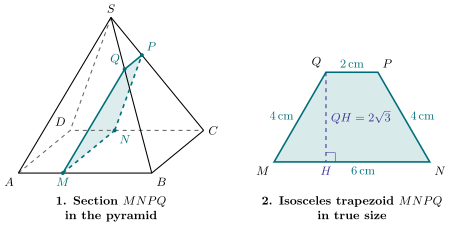
1) Step-by-step construction of the traces of the plane .
- On the base : the plane is parallel to and passes through . The line of intersection is therefore the parallel to passing through : it cuts at a point such that and are rectangles, with , and .
- On the face : the plane is parallel to and passes through . The line of intersection is therefore the parallel to passing through : it cuts at a point .
- On the face : the plane is parallel to and now passes through the point . The line of intersection is therefore the parallel to passing through : it cuts at a point .
- On the face : the points and both belong to and to the face ; it suffices to draw the segment to close the section .
2) Nature of and calculation of the lengths of its sides.
- By construction, and , so by transitivity : the quadrilateral is a trapezoid with bases and .
- In the equilateral triangle with side , since and , Thales' theorem gives:
- In the equilateral triangle with side , since and , Thales' theorem gives:
- Finally, in the equilateral triangle with side , we have and : by the converse of Thales' theorem, , and Thales' theorem gives . Since and , the section is an isosceles trapezoid.
3) Height and area of the isosceles trapezoid . Let be the orthogonal projection of on . By the symmetry of the isosceles trapezoid , we have: In the triangle , right-angled at , the Pythagorean theorem gives the height : The area of the section is therefore:
What the exercise establishes. When a cutting plane is defined by a point and two directions of lines parallel to edges of the solid, the whole section is constructed solely by drawing parallels on the faces, without any extension of an edge outside the solid.
Similar exercises
- Parallel planes in a cube and section by a plane parallel to two lines solved
- The roof theorem in a tetrahedron: line of intersection and point of concurrence solved
- Varignon's theorem in space, bimedians of a tetrahedron and rhombus conditions solved
- Section of a cube using the parallelism of opposite faces solved
- Four-sided roof frame (hip roof) of a traditional house in Mount Lebanon solved
The course of the chapter · All the exercises of the chapter