Mathematics (Grade 10, Lebanon) · Chapter 22 · Tutorial exercise
The roof theorem in a tetrahedron: line of intersection and point of concurrence
Lines and planes – Relative positions · B. Roof theorem and determination of lines of intersection · level 2
Statement
Let be a tetrahedron. We denote by the midpoint of , the midpoint of and the centroid of the triangle (located two thirds of the way along the median coming from , where is the midpoint of ).
1) Prove that the line is parallel to the plane .
2) Justify that the planes and are intersecting, and determine, by means of a theorem of the course, their line of intersection . Construct the points and , and calculate the ratio .
3) Prove that, in the plane , the lines and intersect at a point , then prove by means of the planes and that the point necessarily belongs to the line .
Solution
Strategy. The plane contains the line , which is parallel to , and it meets at the point : the property of a plane containing a line parallel to a second plane (or the roof theorem applied to the planes and containing and ) forces the line of intersection to be the parallel to passing through .
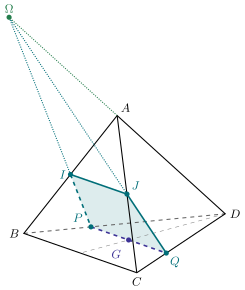
1) Parallelism of and . In the triangle , and are the respective midpoints of and . By the midpoint theorem, the line is parallel to the line and . Since the line is contained in the plane , the criterion for the parallelism of a line and a plane proves that .
2) Line of intersection and ratio .
- The planes and are distinct and have the point in common: they therefore intersect along a line passing through .
- But the plane contains the line , which is parallel to the plane (and more precisely parallel to ). By the roof theorem, the line of intersection is parallel to and to : it is therefore, in the plane , the line passing through and parallel to .
- In the triangle , this parallel to drawn through the centroid (which satisfies on the median ) cuts at and at . By Thales' theorem:
3) Concurrence of , and at .
- In the plane , the lines and are both parallel to , so . The quadrilateral is therefore a trapezoid with parallel bases and . Since , this trapezoid is not a parallelogram: its non-parallel sides and (which are coplanar in ) are therefore intersecting at a unique point .
- Let us find which planes this point belongs to:
- on the one hand, and , so the whole line is contained in the plane , which implies ;
- on the other hand, and , so the whole line is contained in the plane , which implies .
- The point therefore belongs to the intersection of the two planes and . But : we conclude that ; in other words, the three lines , and are concurrent at .
What the exercise establishes. To prove that three lines , and of space are concurrent, we show that the first two are coplanar and intersect at a point , then that this point belongs to the two planes and whose intersection is the third line .
Similar exercises
- Relative positions of lines and planes in a right prism with a triangular base solved
- Parallel planes in a cube and section by a plane parallel to two lines solved
- Varignon's theorem in space, bimedians of a tetrahedron and rhombus conditions solved
- Section of a regular pyramid by a plane parallel to two edges solved
- Section of a cube using the parallelism of opposite faces solved
The course of the chapter · All the exercises of the chapter