Mathematics (Grade 10, Lebanon) · Chapter 4 · Tutorial exercise
Inclusion-exclusion formula and counting with a Venn diagram
Sets · B. Set operations, De Morgan's laws and counting with a Venn diagram · level 2
Statement
A chamber of trades surveys art craftsmen about the materials they work with among cedar wood (), chased metal () and blown glass (). The tally gives:
- craftsmen work with wood, with metal and with glass;
- work with both wood and metal;
- work with both wood and glass;
- work with both metal and glass;
- work with all three materials at once.
1) Calculate using the inclusion-exclusion formula, then find the number of craftsmen who work with wood but not with metal.
2) Construct the Venn diagram of the three sets , and in the universal set of the craftsmen, writing the exact count of each of the eight disjoint elementary regions (starting from the center ).
3) Deduce:
- a) the number of craftsmen who work with wood only;
- b) the number of craftsmen who work with exactly two of the three materials;
- c) the number of craftsmen who work with at least one of the three materials, and the number of those who work with none of them.
Solution
Strategy. In a Venn diagram with three sets, we always fill in the regions from the inside outward: first the triple intersection , then the three regions “exactly two materials” by subtraction, then the three regions “one material only”, and finally the outside .
1) Inclusion-exclusion formula for and . and craftsmen.
2) Filling in the Venn diagram.
- Center (the materials): .
- Exactly two materials:
- wood and metal without glass: ;
- wood and glass without metal: ;
- metal and glass without wood: .
- One material only:
- wood only: ;
- metal only: ;
- glass only: .
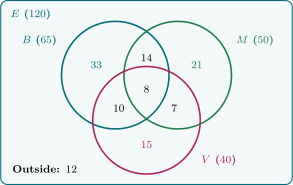
3) Final counts.
- a) Wood only: craftsmen.
- b) Exactly two materials: .
- c) At least one of the three materials: adding up the seven disjoint regions of , we obtain: The number of craftsmen working with none of these three materials is therefore .
What the exercise establishes. Cutting a union into pairwise disjoint elementary regions turns every counting problem into a simple addition of cardinalities of disjoint subsets.
Similar exercises
- Roster notation, membership , inclusion and power set solved
- Proving inclusions and equalities of sets by double inclusion solved
- Set operations, De Morgan's laws, distributivity and partition solved
- Nature of a real number and characterization of decimal numbers solved
- Repeating decimal expansion and proofs of irrationality by contradiction solved
The course of the chapter · All the exercises of the chapter