Mathematics (Grade 10, Lebanon) · Chapter 4 · Tutorial exercise
Problem: Set-based management and arithmetic study of a farming estate in Mount Lebanon
Sets · C. Sets of numbers, repeating expansions and irrationality · level 3 (hard)
Statement
A cooperative estate located on the slopes of Mount Lebanon comprises a universal set of farm plots.
Part A — Set classification of the plots. Among the plots of we distinguish two subsets:
- : the set of plots laid out in dry-stone terraces ();
- : the set of plots connected to the irrigation network (). We also know that plots are neither terraced nor irrigated.
1) Express, using , , the operations , and the complement, the set of plots that are neither terraced nor irrigated, then use one of De Morgan's laws to deduce .
2) Calculate the number of plots that are both terraced and irrigated , the number of plots that are terraced but not irrigated , and the number of plots that are irrigated but not terraced . Check that the four subsets , , and form a partition of .
Part B — Arithmetic study of the dimensions of a terrace. One of the terraces has the shape of a rectangle of width and length (in decameters).
- The ratio of the width to the length has the repeating decimal expansion .
- The diagonal of the rectangle satisfies .
3) Convert into a fraction in lowest terms, and deduce the exact value of when . Is the number an integer?
4) In a second rectangular terrace of width , the diagonal satisfies .
- a) Calculate the length using the Pythagorean theorem.
- b) Prove that for every natural number , if is a multiple of , then is a multiple of (one may examine the three cases , and with ).
- c) Deduce by a proof by contradiction that the length is an irrational number ().
Solution
Strategy. Part A uses in turn De Morgan's law , the complement formula and the inclusion-exclusion formula. Part B combines the conversion of a repeating expansion and the classical scheme of proof by contradiction of the irrationality of a square root.
1) De Morgan's law and cardinality of . The set of plots that are neither in nor in is . By the first De Morgan's law: Since and , we deduce:
2) Cardinalities of the subcategories and partition of . By the inclusion-exclusion formula: We deduce the differences: The four sets (), (), () and () are all nonempty, pairwise disjoint and their union covers (with ): they do form a partition of .
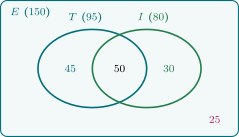
3) Conversion of and calculation of . Setting , we have . For , we obtain:
4) Irrationality of .
- a) In the triangle right-angled at , the Pythagorean theorem gives , that is , hence and (since ) .
- b) Every natural number can be written, according to its remainder in the Euclidean division by , in one of the three forms , or ():
- if , then is not a multiple of ;
- if , then is not a multiple of . By contraposition, if is a multiple of , then can be neither of the form nor of the form : is therefore necessarily a multiple of .
- c) Assume by contradiction that : there exist such that is a fraction in lowest terms (). Squaring, , so is a multiple of . By b, is a multiple of : there exists such that . Then , so is a multiple of , and consequently is also a multiple of . The integers and would both be divisible by , which contradicts the fact that is in lowest terms. So .
What the exercise establishes. Any two subsets and of a universal set always cut into a partition of four disjoint subsets (, , and ). In arithmetic, the proof by contradiction of the irrationality of ( prime) always rests on the fraction being in lowest terms and on the lemma “ divides divides ”.
Similar exercises
- Proving inclusions and equalities of sets by double inclusion solved
- Set operations, De Morgan's laws, distributivity and partition solved
- Inclusion-exclusion formula and counting with a Venn diagram solved
- Nature of a real number and characterization of decimal numbers solved
- Repeating decimal expansion and proofs of irrationality by contradiction solved
The course of the chapter · All the exercises of the chapter