Mathematics (Grade 10, Lebanon) · Chapter 7 · Tutorial exercise
Distances on the graduated line, equations and ring of intervals
Absolute value – Approximation · A. Absolute value, distance on the real line and equations · level 2
Statement
On the real line equipped with a coordinate system , consider the points , and a moving point with abscissa .
1) Translate in terms of distances, then solve in the equations: (a) ; (b) .
2) Solve algebraically in the equation and interpret geometrically the position of the two solution points relative to and .
3) Solve in the double inequality and represent the solution set on the graduated line.
4) Find the set of real numbers satisfying simultaneously and .
5) Limiting case. Discuss, according to the value of the real parameter , the number of solutions of the equation using the geometric interpretation .
Solution
Strategy. We systematically write to make the distance appear, and . For an equation of the type , we use the equivalence or . For a double inequality , we remove from the interval the open interval .
1) First two equations.
- (a) . The points located at distance from have abscissas and : .
- (b) . The only point of the line equidistant from and is the midpoint of the segment , with abscissa : .
2) Equation . Since , the equation is written , which is equivalent to: The solution set is . Geometrically, the length of the segment is ; the two points satisfying are the point located on the segment three quarters of the way from (, ) and the point located outside on the side of (, ).
3) The double inequality . It means that the distance from the point to the center is between and :
- ;
- .
The intersection of these two sets is the union of two segments symmetric with respect to :
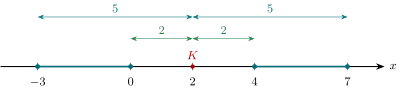
4) System of two inequalities.
- ;
- .
Taking the intersection of with , we obtain .
5) Limiting case: sum of the distances . The distance between and is .
- For every point , we have .
- For every point , we have (and , where is the distance from to the segment ).
Thus: if , the equation has no solution; if , the solution set is the whole segment ; if , the equation has exactly two solutions symmetric with respect to , which are and .
What the exercise establishes. A double inequality () cuts out on the real line two symmetric segments . The sum of the distances reaches its minimum on the whole segment .
Similar exercises
- Radicals, comparisons and writing without absolute value solved
- Weighted sum of absolute values as a function, and minimum solved
- Centered intervals, intersection and condition on a parameter solved
- Double inequalities, truncations, roundings and uncertainty on a quotient solved
- Triangle inequality and error control on a polynomial solved
The course of the chapter · All the exercises of the chapter