Mathematics (Grade 10, Lebanon) · Chapter 8 · Tutorial exercise
Problem: Ferris wheel and trigonometric lines of
Trigonometric lines · C. Trigonometric identities, symmetric polynomials and synthesis problem · level 3 (hard)
Statement
This problem has two independent parts.
Part A — Tracking a gondola on a Ferris wheel. On a seaside promenade, a Ferris wheel modeled as a circle with center and radius rotates in a vertical plane about its axle , located at a height of above the ground. In the vertical plane of the wheel equipped with a positively oriented orthonormal coordinate system (unit: the meter, horizontal and vertical pointing upward), a gondola starts at time from the point and rotates in the positive direction at constant speed: at time (expressed in minutes), the radius has swept an oriented angle of measure radians.
- 1) a) Find the duration (in minutes) of a full turn of the wheel, as well as the exact length of the circular arc traveled by the gondola in minute.
- 1) b) Justify that the altitude (in meters) of the gondola above the ground at time is given by: What are the minimum altitude and the maximum altitude reached by the gondola during one turn?
- 1) c) Calculate the exact altitude of the gondola at times , and (first finding the principal measure of ).
Part B — Geometric construction of the trigonometric lines of (). On the trigonometric circle with center , consider the points , and the point , image of the real number (), with coordinates . We denote by the orthogonal projection of on the -axis .
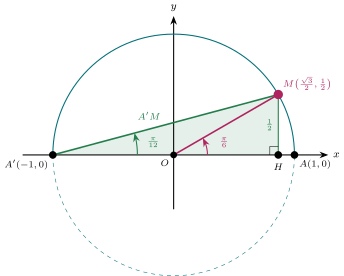
- 2) a) Justify that the triangle is isosceles at , then prove that the acute angle measures ().
- 2) b) Express the exact lengths and in the right triangle . Deduce that:
- 2) c) Using the Pythagorean theorem in the right triangle , prove that . Check on the other hand that , then deduce the exact length .
- 2) d) By expressing and in the right triangle , prove that: then give without further calculation the exact values of , and .
Solution
Strategy. In part A, the ordinate of a point on a circle with center and radius is , to which is added the height of the axle above the ground. In part B, the inscribed angle theorem (or the isosceles triangle ) makes the half of the central angle appear in the right triangle .
Part A — Motion of the gondola on the Ferris wheel.
1) Period, arc length and altitude of the gondola.
- a) The wheel completes a full turn when the angle is equal to radians: In minute, the angle swept is ; on the circle of radius , the length of the arc traveled is:
- b) In the coordinate system , the ordinate of the gondola relative to the center is . Since the center is located above the ground, the altitude above the ground is indeed: Since , we have , that is a minimum altitude of (at the lowest point, for ) and a maximum altitude of (at the top, for ).
- c) Let us calculate the altitude at the three times:
- for : ;
- for : ;
- for : the angle is , whose principal measure is . Since , we find .
Part B — Trigonometric lines of .
2) Geometric study of the triangle .
- a) The points and belong to the trigonometric circle with center , so : the triangle is isosceles at . The vertex angle is the supplement of , that is . The two base angles and are therefore equal to:
- b) In the triangle right-angled at , we have: We immediately deduce the cotangent and the tangent of the acute angle :
- c) By the Pythagorean theorem in the triangle right-angled at : Moreover, let us expand the proposed square: Since and , we conclude that .
- d) In the right triangle : and Finally, since , the arcs and are complementary, which exchanges cosine and sine as well as tangent and cotangent:
What the exercise establishes. Joining the point to the point of the trigonometric circle builds an isosceles triangle with base angle : the right triangle then makes it possible to calculate geometrically the trigonometric lines of half of a special angle.
Similar exercises
- Calculating the four trigonometric lines in a given quadrant solved
- Formulas for associated angles and reduction of expressions solved
- Calculating trigonometric sums and products by symmetry solved
- Proving trigonometric identities solved
- Algebraic calculations starting from solved
The course of the chapter · All the exercises of the chapter