Mathematics (Grade 10, Lebanon) · Chapter 9 · Tutorial exercise
Equalities of vectors, chained parallelograms and midpoints
Vectors in the plane · A. Equality of vectors, parallelograms and Chasles' relation · level 1 (application)
Statement
Let be a parallelogram. We construct the point such that the quadrilateral is a parallelogram, as well as the point defined by the vector equality .
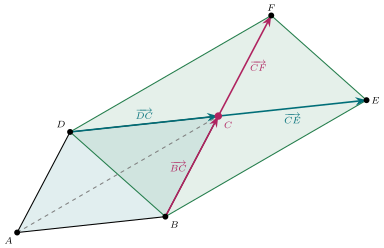
1) Prove that , and deduce what the point represents for the segment .
2) What is the nature of the quadrilateral ? Deduce that and state what the point represents for the segment .
3) Deduce from the two previous questions the nature of the quadrilateral , then name the vector of the figure, other than itself, that is equal to the vector .
Solution
Strategy. We translate each parallelogram into an equality of two vectors, paying attention to the order of the vertices ( parallelogram ), then we use the transitivity of the equality of vectors ( and ).
1) Midpoint of the segment .
- Since is a parallelogram, we have .
- Since is a parallelogram (following the order of the vertices ), the opposite sides and define the equal vectors .
By transitivity of the equality of vectors, we obtain: This vector equality means that the point is the midpoint of the segment .
2) Midpoint of the segment . By assumption, , which amounts to saying that the quadrilateral is a parallelogram. Its other opposite sides therefore give the vector equality . Now, in the parallelogram , we also have . By transitivity: The point is therefore also the midpoint of the segment .
3) Nature of the quadrilateral . In the quadrilateral , the diagonals are the segments and . By the two previous questions, these two diagonals have the same midpoint . The quadrilateral is therefore a parallelogram. Consequently, : it is the only vector of the figure, other than , that is equal to it. We recover this by Chasles' relation: (because in and in ), and (because is the midpoint of ).
What the exercise establishes. Two parallelograms that share a common side provide two vectors equal to the same third one: the equality expresses both the collinearity of the three points , , and the equality of the lengths .
Similar exercises
- Reducing sums and differences of vectors by Chasles' relation solved
- Algebraic calculation on vectors and vector systems solved
- Constructing points defined by a vector equation solved
- Algebraic recognition of collinear vectors, with a parameter solved
- Decomposition in a geometric basis and proof of collinearity solved
The course of the chapter · All the exercises of the chapter