Mathematics (Grade 11, Lebanon) · Chapter 10 · Tutorial exercise
General equations , and equations on an interval
Elementary trigonometric equations · B. Elementary and quadratic trigonometric equations · level 2
Statement
1) Solve in , then in , the equation . Place the solutions on the trigonometric circle.
2) Solve in the equation using associated angles.
3) Solve in the equation .
4) Limiting case. Solve in the equation , taking the domain of definition into account. Are all the values found valid?
Solution
Strategy. We bring both sides to the same trigonometric function (with no minus sign in front) thanks to the associated angles and . When we divide by an integer to isolate , we also divide the period , which becomes .
1) Equation . It is equivalent to ():
- ;
- or .
In , the first family gives (), and the second gives (), () and (). Thus .
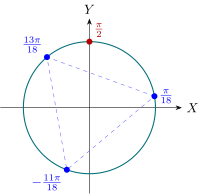
2) Equation . Since , the equation can be written , that is ():
- , which gives in the values (), () and ();
- or , which gives () in .
We therefore obtain .
3) Equation . Let us use . The equation is equivalent to ():
- ;
- or .
4) Limiting case: domain of existence of an equation in tangent. We first need and (), that is . Now, on this domain, the equality is equivalent to , that is (). But every value gives , a value for which is not defined! All the candidate values are therefore excluded by the domain of definition, and the equation has no solution: .
What the exercise establishes. For , it is essential to check that the solutions of do not make vanish: a forbidden value can eliminate a whole family of solutions.
Similar exercises
- Principal measures, Chasles' relation and properties of oriented angles solved
- Locating points in polar coordinates and geometric configurations solved
- Fundamental equations in cosine, sine, tangent and cotangent solved
- Trigonometric equations reducing to quadratic equations solved
- Trigonometric inequalities on the circle and sign of a product solved
The course of the chapter · All the exercises of the chapter